
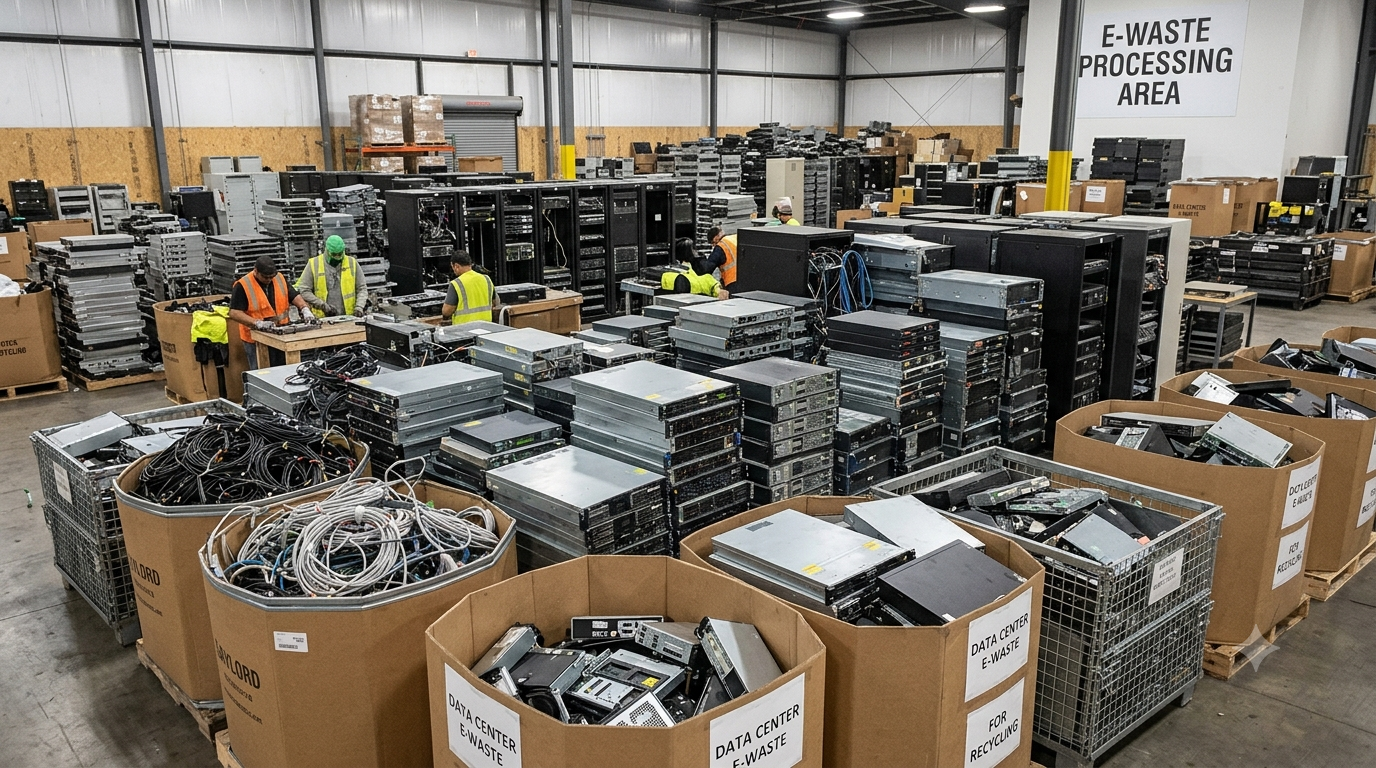
Data center decommissioning services handle the secure dismantling of facility infrastructure, certified destruction of all data on storage media, and auditable disposition of hardware through compliant channels. This is required because the average data breach costs $10.22 million, and a single unwiped hard drive can trigger a mandatory public disclosure under HIPAA or the SEC’s cybersecurity rules. When you’re retiring a data center, every storage device is a regulatory liability until it’s sanitized to NIST 800-88 standards and documented down to the serial number.
This guide covers what a qualified ITAD provider should deliver — the certifications to require, the documentation to expect, the chain of custody controls that protect you, and the evaluation criteria that separate a defensible partner from a vendor that will leave holes in your audit trail.
What certified data center decommissioning services include
A certified ITAD provider delivers four categories of service during a decommissioning project: data destruction to federal standards, serialized chain of custody tracking, compliant environmental recycling, and auditable documentation that holds up under regulatory scrutiny. The certifications backing those services are what make them defensible.
Certifications and compliance standards to require
Internal corporate policies are not sufficient. The ITAD partner executing your decommissioning must meet independently verified frameworks. Here’s what to require and why each one matters:
| Standard | What It Covers | Why It Matters |
|---|---|---|
| NIST 800-88 | Media sanitization methods (Clear, Purge, Destroy) | Federal benchmark for data destruction |
| IEEE 2883-2022 | Updated sanitization specs for NVMe, flash, SMR drives | Companion to NIST for current-gen media |
| NAID AAA | Data destruction vendor certification via unannounced audits | Third-party verified security compliance |
| R2v3 | Responsible electronics recycling and downstream handling | Environmental and export law accountability |
| ISO 27001 | Information security management | Validates data protection controls |
| ISO 14001 | Environmental management systems | Proves sustainable operations |
| ISO 9001 | Quality management systems | Standardized process reliability |
| ISO 45001 | Occupational health and safety | Worker protection during physical teardown |
NIST 800-88 defines three sanitization levels. “Clear” uses logical software overwriting for standard data. “Purge” employs cryptographic erasure for sensitive data on solid-state drives. “Destroy” — shredding, disintegration, or incineration — is mandated for classified data or physically failing media. The appropriate method depends on data sensitivity and the storage medium.
IEEE 2883-2022 supplements NIST 800-88 with updated technical specifications for executing Clear, Purge, and Destroy on current-generation media — NVMe drives, flash memory, and Shingled Magnetic Recording (SMR) drives — that didn’t exist when NIST 800-88 was originally published.
NAID AAA, administered by i-SIGMA, is the security standard for data destruction vendors. Achieving AAA certification requires passing unannounced audits that assess facility physical security, personnel background checks, and the mechanical effectiveness of destruction equipment. It transforms data destruction from a vendor promise into a third-party verified, legally defensible event.
R2v3, administered by Sustainable Electronics Recycling International (SERI), governs the environmental processing of electronic equipment. It prevents end-of-life hardware from entering unregulated recycling streams overseas — a practice prohibited by the Basel Convention — by requiring verified downstream materials chains and prioritizing reuse over raw material destruction.
ISO 27001 specifies requirements for information security management, validating that a vendor’s data protection controls hold up against internal and external threats. ISO 14001 provides the framework for environmental management systems, minimizing ecological impact. Both are internationally recognized and frequently required for enterprise and government contracts.
Documentation your ITAD provider should deliver
Executing a secure shutdown is half the job. The other half is proving it happened. Every qualified provider should produce documentation that holds up under regulatory inquiries, financial audits, and internal security reviews.
Certificates of data destruction. A Certificate of Data Destruction (CoD) is formal legal proof that data on each asset was securely sanitized or destroyed. To be valid for regulatory audits, each certificate must be itemized by the exact serial number of the storage media, state the NIST sanitization method used, and include the timestamp and verifying technician’s signature. Batch certificates that state a volume of drives were destroyed without serial-level detail are non-compliant and will trigger audit failures.
Serial-level asset reporting. Every device removed from the data center — from network switches to power supplies and transceivers — should appear in a line-item report showing its specific disposition path. This is your defense if an asset bearing a corporate property tag is later discovered in the secondary market and its origins are questioned.
Settlement and resale records. If equipment retained enough value to be resold, you need clear settlement records documenting the transaction and the general category of the buyer. This proves organizational assets did not enter gray-market networks and provides transparent accounting for capital recovered.
Environmental and social impact reports. Reports quantify pounds of e-waste diverted from landfills, carbon reduction figures, and — for nonprofit ITAD partners — community outcomes like devices redeployed to underserved populations. These metrics are required for ESG reporting and Scope 3 emissions disclosures under Category 5 (Waste Generated in Operations) of the GHG Protocol, which is scrutinized under the EU Corporate Sustainability Reporting Directive (CSRD) and SEC climate rules.
How ITAD providers maintain chain of custody from rack to recycler
Chain of custody is the documented, unbroken trail proving who handled each asset at every stage of the retirement lifecycle. If tracking is lost — even momentarily — the risk of a data breach or stolen hardware rises sharply. Regulators treat a lost server the same as a stolen one: both are data exposure events.
A qualified provider maintains these checkpoints:
| Stage | What Your Provider Should Do | Documentation You Receive |
|---|---|---|
| On-site pickup | Generate a signed manifest cross-referencing exact serial numbers before hardware is loaded | Signed departure manifest |
| Transport | Use GPS-tracked vehicles; seal hardware in containers with tamper-evident seals | Transport tracking logs |
| Receiving at ITAD facility | Run an intake scan that must match the departure manifest; investigate any discrepancies immediately | Intake verification report |
| Processing | Log a sanitization or physical destruction event against each asset serial number | Per-asset sanitization record |
| Final disposition | Produce a comprehensive settlement showing the outcome per unit — resale, recycling, or destruction | Settlement report |
Certified providers offer real-time tracking portals connected to their ERP systems, giving you operational visibility from pickup through final disposition.
A single missing hard drive can trigger a mandatory public breach notification under HIPAA or the SEC’s cybersecurity disclosure rules. Regulators do not differentiate between stolen and lost — both constitute a data exposure event. The chain of custody documentation your provider produces is what proves no asset went unaccounted for.
How to evaluate a data center decommissioning partner
Data center environments contain intellectual property and network architecture too sensitive for a standard recycler or general logistics firm. Here’s how to separate a qualified partner from a risky vendor.
Verify the certification stack
Marketing claims are meaningless without independent verification. Require NIST 800-88 alignment, NAID AAA, R2v3, and relevant ISO certifications (9001, 14001, 27001, 45001). Ask for proof — certifications should be current, actively maintained, and auditable by your security team. If a vendor can’t produce current certificates on request, move on.
Assess logistics and geographic coverage
Multi-site enterprise footprints require robust, secure logistics. Ask whether the partner handles varied scenarios: standard palletized freight, white-glove de-racking of liquid-cooled GPU clusters, and secure parcel shipping for remote edge locations. Nationwide or global reach matters for organizations running rolling multi-site decommissioning projects where you need standardized security controls across every facility.
Demand reporting depth
The only defense against a regulatory audit is impeccable documentation. Expect serial-number-level certificates of destruction, real-time asset tracking portals, and detailed financial settlement reports. If a provider relies on batch reporting — for example, “1,200 pounds of hard drives destroyed” without serial-level detail — treat that as an immediate red flag.
Ask about value recovery and impact
Some ITAD partners elevate hardware disposal from a cost center into value recovery and community enablement. Ask whether viable devices are shredded for commodity recovery or refurbished for extended use. Refurbishment drastically reduces the carbon footprint versus manufacturing new electronics — manufacturing generates approximately 24% of a data center’s total lifetime emissions before the equipment processes a single byte of data. Partners that prioritize reuse can also generate tax benefits when devices are donated through a 501(c)(3) entity.
Evaluate red flags
Watch for these warning signs during vendor evaluation:
- No NAID AAA certification or inability to produce current audit documentation
- Batch-only certificates of destruction without serial-level itemization
- No real-time tracking portal or GPS-monitored transport
- Vague language about downstream recycling partners
- No settlement reports showing where resold assets went
- Resistance to facility tours or security audits by your team
What happens during the decommissioning process
A standard decommissioning follows five sequential phases. Understanding this process helps you evaluate whether your ITAD provider is executing each step to the standard your compliance team requires.
Phase 1. Inventory and asset audit
Your provider maps all hardware down to the serial number — servers, storage arrays, networking equipment, power distribution units (PDUs), and structured cabling. They document interdependencies between systems to ensure nothing still in production gets pulled.
One common hazard in legacy facilities: “comatose servers” — devices drawing power and network resources but performing no active compute function. These get missed during previous migrations and create untracked data exposure. A thorough audit reconciles the physical floor against the organization’s Configuration Management Database (CMDB) before anyone touches hardware, resolving all discrepancies first.
Phase 2. Data backup and migration validation
Before your provider powers down any equipment, your internal teams must verify all critical data is backed up or migrated — whether to a public cloud environment, a colocation cage, or a modernized on-premises facility. Migration must be formally signed off by the relevant business application owners. No qualified provider should proceed until this validation is complete.
Phase 3. Secure data sanitization and destruction
Every storage device requires certified erasure or physical destruction per NIST 800-88 and IEEE 2883-2022 protocols. Your provider should address primary storage and the embedded media that standard procedures often miss — RAID controllers, NVMe cache drives, and motherboard batteries that can retain network configuration data or cached proprietary information. Leaving a single embedded controller unwiped can constitute a reportable data breach.
Phase 4. Physical extraction and secure transport
Specialized technicians disconnect racks, cabling, power distribution, cooling infrastructure, and UPS systems. This is especially complex in high-density environments where retrofitted liquid cooling systems or heavy busways must be dismantled without damaging active adjacent systems. Every asset gets scanned and logged from the moment it leaves the rack, then transported via GPS-monitored vehicles in sealed, tamper-evident containers.
Phase 5. Value recovery and final disposition
Your provider tests, grades, and routes extracted hardware based on condition and market value:
- Resale and remarketing. Viable servers, networking gear, storage arrays, and AI accelerators sell on secondary markets. In early 2026, supply chain bottlenecks drove prices sharply higher — lead times for new high-capacity hard drives reached 104 weeks and new servers stretched to 26 weeks, while refurbished models shipped in one to two weeks.
- Internal redeployment. Equipment that no longer meets primary production demands can return to your organization for development/testing environments or disaster recovery sites.
- Donation. Working devices go to registered nonprofits, generating tax deductions and social impact metrics for ESG reporting.
- Responsible recycling. Non-viable hardware gets separated into base commodities — aluminum, steel, plastics, and rare earth metals — and sent to R2v3 or e-Stewards certified recyclers.
Best practices for overseeing your decommissioning project
Even with a qualified ITAD partner, these operational habits protect your organization across every project.
1. Require serialized documentation from day one
Certificates of destruction are only legally valid when tied to a specific hardware serial number and its corresponding intake manifest. Establish this expectation in your contract — not after the project starts.
2. Confirm NIST 800-88 method selection per asset
Your provider should apply Clear, Purge, or Destroy based on each asset’s data sensitivity. Verify they’re making deliberate method selections — not defaulting to the same approach for every drive regardless of classification level.
3. Audit the chain of custody at each checkpoint
Review the departure manifest, transport logs, and intake verification reports as they’re produced. Don’t wait for the final settlement report to discover discrepancies.
4. Ensure your team is trained before the project starts
Staff involved in the handoff must understand data security protocols, physical handling requirements, and documentation expectations. Untrained personnel bypassing scanning protocols or mishandling embedded storage media are a leading cause of compliance gaps.
5. Retain records for regulatory timelines
Keep all project records — asset manifests, photographic evidence of physical destruction, technician sign-offs, and transport logs — for the duration your regulatory framework requires. For federal agencies and defense contractors, records must conform to FISCAM formatting standards.
Why organizations are decommissioning data centers in 2026
If you’re evaluating ITAD services, you likely already know why you need to decommission. But the scale of the current wave affects provider capacity and pricing, so the context matters.
Three situations drive most projects:
Cloud migration. On-premises hardware becomes a financial liability when workloads shift to public cloud or colocation facilities. Legacy data centers become idle racks drawing power, accumulating depreciation, and creating uncontrolled security exposure.
Compressed hardware refresh cycles. AI and high-performance computing have compressed traditional five-to-seven-year refresh cycles down to 18–36 months, generating continuous rolling pipelines of retired servers, storage arrays, and network switches.
Consolidation. Mergers, acquisitions, and corporate relocations force infrastructure downsizing. Redundant facilities must be liquidated without exposing proprietary data — including sensitive merger information.
The scale is unprecedented. Global data center electricity demand is projected to double by 2030, climbing from 448 TWh to an estimated 980 TWh. In the U.S. alone, data centers consumed 183 TWh of electricity in 2024 — more than 4% of the national grid. As operators deploy liquid-cooled racks drawing 60–100+ kW to support AI workloads, older air-cooled facilities are being retired at record rates. This creates demand pressure on ITAD providers — which is why vetting your partner’s capacity and certification status matters more than ever.
E-waste, ESG reporting, and the compliance case for responsible recycling
IT hardware is a major and growing source of global electronic waste. In 2022, the world generated 62 million metric tonnes of e-waste, yet only 22.3% was formally collected and properly recycled. Poor decommissioning practices send usable equipment to landfills or unregulated scrap yards, releasing toxic heavy metals and squandering the embodied carbon generated during manufacturing.
Certified decommissioning projects produce ESG reporting data that sustainability teams increasingly treat as a strategic deliverable:
- Pounds of e-waste diverted from landfills
- Carbon reduction figures aligned with GHG Protocol Scope 3 Category 5 guidelines, capturing emissions avoided through refurbishment versus new procurement
- Devices refurbished and redeployed, serving as social impact metrics for corporate responsibility programs
Sustainability directors and compliance officers now treat ITAD not as a disposal task but as a strategic ESG program essential to meeting mandated climate disclosure requirements under the CSRD and SEC frameworks. For organizations evaluating ITAD partners, asking for sample ESG reports from previous projects is a straightforward way to assess whether a provider can deliver audit-ready sustainability data.
Get certified decommissioning with built-in compliance documentation
Human-I-T holds the same certifications as top-tier commercial ITAD providers — NIST 800-88 compliance, NAID AAA facility security, and R2v3 downstream recycling verification. Every asset gets serialized tracking, a per-device Certificate of Destruction, and a full settlement report.
The difference: as a registered 501(c)(3) nonprofit, Human-I-T adds tax benefits and auditable social impact metrics on top of enterprise-grade security. In 2024, their programs diverted 4 million pounds of e-waste from landfills and distributed 525,000 computers to individuals and families in need.
Contact Human-I-T to get a quote or schedule a secure, tracked pickup.
Frequently asked questions about data center decommissioning services
What should a Certificate of Data Destruction include?
A valid Certificate of Data Destruction must be itemized by the exact serial number of each storage device, state the NIST 800-88 sanitization method used (Clear, Purge, or Destroy), and include the timestamp and verifying technician’s signature. Batch certificates without serial-level detail are non-compliant and will not hold up in regulatory audits.
What certifications should an ITAD partner have?
At minimum, require NIST 800-88 compliance, NAID AAA certification (third-party audited destruction security), R2v3 (responsible recycling), and ISO 27001 (information security management). ISO 14001, ISO 9001, and ISO 45001 add environmental, quality, and safety verification. Ask for current proof — expired or lapsed certifications offer no protection.
How long should my ITAD provider retain decommissioning records?
Record retention timelines depend on your regulatory framework. HIPAA requires six years, SOX requires seven, and federal agencies may require longer under FISCAM standards. Clarify retention expectations in your contract before the project starts, and ensure your provider’s document management system can meet them.
How much does data center decommissioning cost?
Costs vary based on total asset volume, equipment type, facility location, and service level — including whether you need on-site mobile shredding or secure off-site processing. Some certified nonprofit ITAD partners offer free pickup and processing for qualifying hardware volumes, offsetting costs through resale of viable components and tax-deductible charitable donations.
How long does a typical data center decommissioning project take?
A single enterprise rack can be completed in a few weeks. A full multi-megawatt colocation facility or hyperscale availability zone can take several months. Timelines depend on inventory size, workload migration complexity, live network interdependencies, and logistics coordination.
What is the difference between data center decommissioning and data center migration?
Migration moves digital workloads, applications, and sometimes physical hardware to a new location or cloud environment. Decommissioning permanently retires, sanitizes, and disposes of the legacy infrastructure left behind that will not be reused. Most projects involve both — migration happens first, decommissioning follows.
Can data center decommissioning be free?
Yes. Some ITAD providers — especially nonprofits like Human-I-T — offer secure, free pickup and processing for qualifying hardware volumes. They recover value through remarketing working components and receive the hardware as tax-deductible donations, absorbing the logistics and sanitization costs.
What happens to decommissioned equipment after it leaves the data center?
Equipment is transported via GPS-tracked logistics to a certified ITAD facility, where it’s inventoried and all data-bearing media is sanitized to federal standards. Based on condition and market value, hardware is then routed for commercial resale, charitable donation, or responsible commodity recycling. You should receive a settlement report showing the outcome for every unit.
What is NIST 800-88?
NIST Special Publication 800-88 is the federal standard for media sanitization. It defines three levels — Clear, Purge, and Destroy — each specifying the techniques required based on data sensitivity and storage media type. It is the industry benchmark for data destruction across both government and commercial sectors. IEEE 2883-2022 provides updated technical specs for applying these methods to current-generation NVMe, flash, and SMR drives.