

TL;DR
Internet in New York is expensive because providers pile hidden fees — equipment rentals, installation charges, credit-check deposits, and post-promotional price hikes — on top of advertised rates, routinely doubling or tripling the sticker price. Approximately 30% of NYC households — nearly 2.5 million residents — lack both mobile and home broadband services, according to the NYC Office of Technology and Innovation. If you’re an income-qualified New Yorker, you can skip the fee traps entirely through Human-I-T’s $14.99/month unlimited hotspot with no contracts, no hidden fees, and free tech support.
Table of Contents
- What Are You Really Paying for Beyond the Advertised Rate?
- Why Are New York Families Being Priced Out of the Internet?
- Does New York’s $15 Internet Law Actually Work?
- What’s the Real Alternative to Overpriced Internet in New York?
- FAQ
What Are You Really Paying for Beyond the Advertised Rate?
You’re paying for a pricing structure engineered to extract maximum profit at every stage — from the moment you sign up through every month you stay connected. That "$50-per-month" plan? It becomes $127 once installation fees, equipment rentals, and post-promotional hikes are factored in. The price on the billboard is almost never the price on your bill.
According to analysis by Consumer Reports, eight of the top 12 internet providers charge equipment fees ranging from $10.00 to $19.99 monthly on top of their advertised rates. Installation adds another $30 to $100. Setup fees pile on even more. Research shows only 5% of low-income families can afford high-speed internet without financial assistance.
These aren’t oversights. They’re calculated strategies designed to keep working families paying more than they can afford.
Installation and Setup Fees (The First Shock)
Before your internet even works, companies hit you with charges that can cost more than your first month of service. Spectrum demands $30 for self-installation or $65 if you want a technician. Xfinity pushes the envelope further — up to $100 for professional installation, though they’ll graciously let you struggle through self-installation for just $15.
Verizon Fios charges a $99 setup fee, and depending on your credit score, they might demand a deposit on top of that. Even choosing the cheapest self-install option puts you $15–30 in the hole before you stream your first video.
Equipment Rental Fees (The Monthly Drain)
Providers cash in hardest on equipment. That modem and router you need to actually use the internet? Not free. Xfinity charges $15 monthly for their xFi Gateway equipment rental. Spectrum tacks on $10 per month for their Advanced Wi-Fi service — a figure confirmed by CNET’s 2025 analysis.
The math gets ugly fast. Xfinity customers spend roughly $180 annually just renting equipment they’ll never own. Over two years, that’s $360 — enough to buy your own high-end router and modem outright.
And promotional pricing expires faster than milk. Spectrum customers watch their bills spike by $30 once the honeymoon period ends. That "$50" plan becomes $80 or more. Permanently. No warning, no negotiation, no escape clause.
The Costs Nobody Puts in the Ad
Credit checks can trigger security deposits if your score doesn’t meet provider standards. Installation appointments force you to take time off work — unpaid hours that companies never factor into their "affordable" calculations. When self-installation inevitably fails, technical support calls eat more of your day while you troubleshoot problems that shouldn’t exist in the first place.
These are calculated strategies designed to extract maximum profit from customers who just need to get online. They’re what makes internet expensive in New York. And they’re creating a digital divide that’s tearing communities apart.
Why Are New York Families Being Priced Out of the Internet?
Those hidden fees don’t exist in a vacuum. They’re pricing out entire communities, splitting New York along economic lines in ways that compound every other inequality.
The Scope of New York’s Digital Divide
According to the NYC Office of Technology and Innovation, approximately 30% of NYC households — nearly 2.5 million residents — lack both mobile and home broadband services, limiting their ability to stay connected at home. The Bronx is hit hardest: a 2025 Center for an Urban Future report found that 22.4% of Bronx households lack broadband at home, compared to 18% in Queens and significantly less in Manhattan.
Research shows 37% of NYC households earning under $20,000 annually lack internet access, compared to just 5% of families making $75,000 or more. When internet costs more than groceries, families are forced to choose. No one should have to choose between food and getting online.
Real Impact on Real Lives
Digital poverty destroys opportunities before they start. The Community Service Society found that 40% of low-income New Yorkers couldn’t complete online schooling due to internet barriers. Nearly one-third couldn’t access job-related training programs.
Device poverty compounds the crisis. According to state analysis, 8% of New Yorkers rely solely on smartphones for internet access. Try filling out a job application on a cracked phone screen with limited data.
The Opportunity Cost Crisis
Unemployment and digital disconnection feed each other in vicious cycles. Kids fall behind classmates who have reliable internet at home. Healthcare moves online through telehealth platforms that demand stable connections — connections low-income families can’t afford. Lack of access to online opportunities quite literally perpetuates the cycle of poverty across whole generations.
The infrastructure exists. The problem isn’t availability. What makes internet expensive in New York is affordability designed to exclude. New York lawmakers have noticed — and they’re fighting back with legislation that sounds promising. At least on paper.
Does New York’s $15 Internet Law Actually Work?
Partially. The Affordable Broadband Act — which officially took effect in 2024, making New York the first state in the nation to require internet service providers to offer discounted plans — represents real progress. But implementation gaps and limited scope mean it hasn’t solved the affordability crisis.
What the Affordable Broadband Act Promises
The law mandates that qualifying households can access internet for $15 monthly at 25 Mbps or $20 monthly for 200 Mbps speeds. According to the Benton Institute for Broadband & Society, large ISPs — those with over 20,000 subscribers — are required to offer one of these two affordable plans to qualifying households. Unlike those deceptive advertised rates, these prices must include everything: taxes, equipment fees, usage charges — the works.
Notably, New York legislators have already introduced Assembly Bill A190 (2025), which would push the price down further — requiring broadband providers to offer service to qualifying low-income consumers for no more than $5 per month.
The Implementation Gap
Many providers are still requesting exemptions, claiming economic hardship. Others comply selectively — offering mandated plans only in specific ZIP codes or to customers who navigate bureaucratic hoops that would make a tax attorney dizzy.
The eligibility process itself creates barriers. Families must prove income levels and provide documentation through application systems that assume digital literacy skills many lack. Geographic availability remains spotty, leaving entire communities still priced out despite the law’s existence.
Why It’s Still Not Enough
Even when the law works perfectly, it solves only part of the puzzle. Cheap internet means nothing without a computer or tablet. The $15 plan doesn’t include device access, digital literacy training, or technical support.
The law represents progress. But progress toward what? A world where connectivity comes with comprehensive support, transparent pricing, and genuine accessibility — not just a discounted price for a single service.
What’s the Real Alternative to Overpriced Internet in New York?
Human-I-T provides what the $15 law promises but can’t deliver alone: comprehensive digital inclusion that addresses every barrier families face — connectivity, devices, training, and support — in one package with transparent pricing.
Beyond Just Internet Access
Human-I-T’s Franklin T10 Hotspot costs just $14.99 monthly with unlimited internet access — no contracts, no hidden fees, no surprises. That’s cheaper than most families spend on coffee each week.
But connectivity means nothing without devices. We offer refurbished laptops starting at $130, with brand names like HP, Dell, and Apple. Every device comes with a warranty and free tech support. Every purchase includes payment plans for qualifying families and income-based discounts through our free Gold Membership that make technology truly accessible.
Real Support That Works
Unlike providers who abandon customers after installation, Human-I-T provides one year of free technical support with every device purchase. Gold Members get access to free digital skills training courses through Cisco.
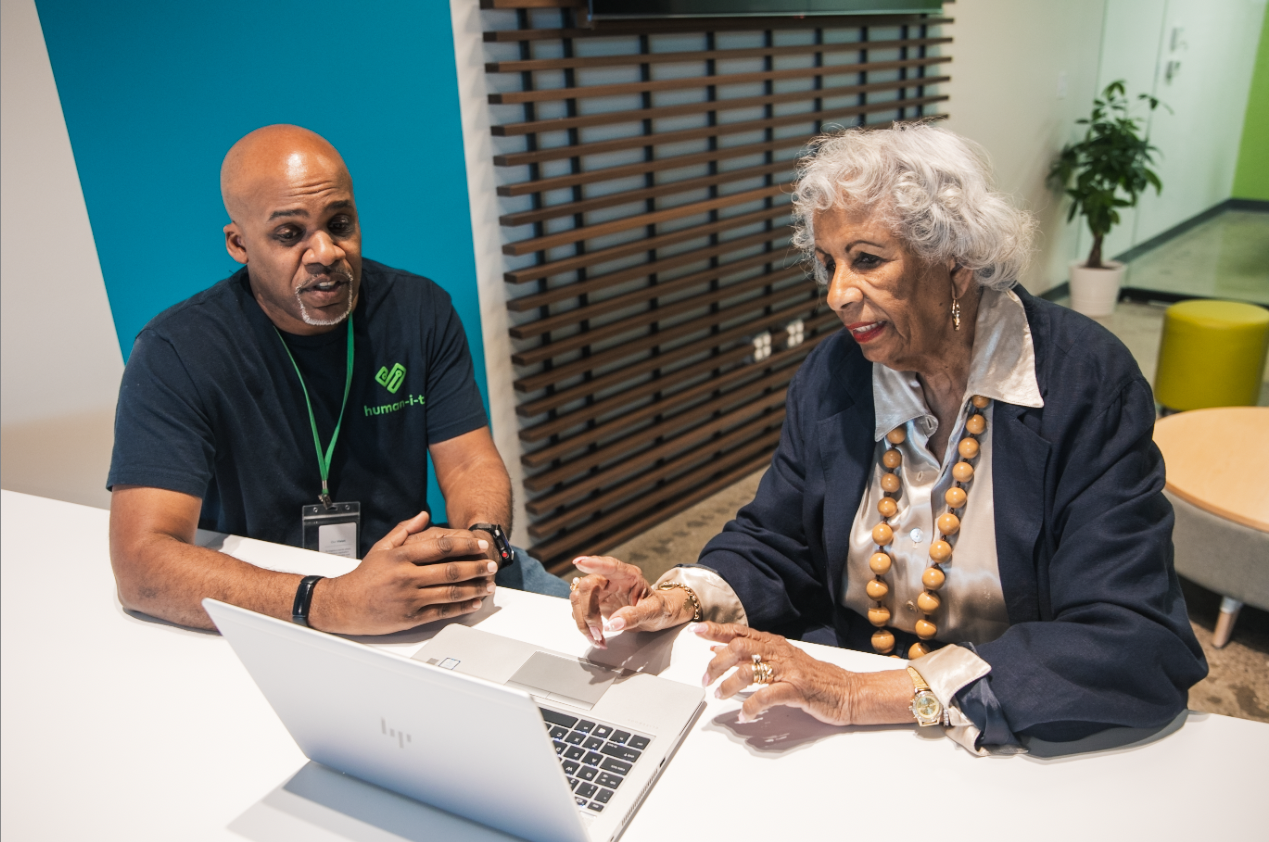
You get one-on-one support from the beginning. Digital navigators offer personalized guidance — assessing individual needs and creating customized plans for devices, connectivity, and skills training.
No individual is digitally left behind here.
Stop paying hidden fees for substandard service. Your family deserves better than corporate greed disguised as "affordable" internet.
Get connected today and discover what truly affordable internet looks like. No gimmicks. No gatekeeping. Just real access for real families.
FAQ
Why is internet so expensive in New York compared to other cities?
New York internet is expensive because providers layer hidden fees — equipment rentals of $10–$15/month, installation charges up to $100, credit-check deposits, and post-promotional price hikes of $30 or more — on top of already inflated advertised rates. Limited competition in many neighborhoods means providers face little pressure to lower costs.
Does New York’s $15 internet law apply to me?
The Affordable Broadband Act applies to New Yorkers who receive benefits like SNAP or Medicaid. Qualifying households can access internet for $15/month at 25 Mbps or $20/month at 200 Mbps, inclusive of all fees and equipment. However, not all providers comply consistently, and the application process can be cumbersome.
What happened to the Affordable Connectivity Program (ACP)?
The federal Affordable Connectivity Program ended on June 1, 2024. Since its termination, states like New York have stepped in with their own affordability mandates, including the Affordable Broadband Act. If you relied on the ACP, check your eligibility for Human-I-T’s $14.99/month unlimited hotspot or New York’s state-mandated plans.
How can I get affordable internet in New York without hidden fees?
Human-I-T offers unlimited internet at $14.99/month with no contracts, no hidden fees, and no credit checks. Gold Members also get access to refurbished laptops starting at $130, free tech support for one year, and digital skills training — everything you need to get and stay connected.
Can I get a computer and internet together at a low cost in New York?
Yes. Human-I-T bundles affordable internet with refurbished devices and free support. Through the Gold Membership program, income-qualified families access discounted laptops, $14.99/month unlimited hotspot internet, digital skills training through Cisco, and one-on-one digital navigator support. Fill out the form today to check your eligibility and take the first step toward real digital inclusion.