
Our certifications cover the stages they apply to: NAID AAA covers our in-facility information destruction; ISO covers quality, environmental, and occupational health management at our facilities; R2v3 covers downstream recycling partners. Transportation segments handled by downstream partners may fall outside our NAID certification scope.
Certified Secure Data Destruction
Get Your Questions Answered About Our Data Destruction Practices22
pounds of e-waste diverted from landfills
524
Technology items distributed of all time
19.2
Parts recorded and processed
1.75
Components recovered for reuse
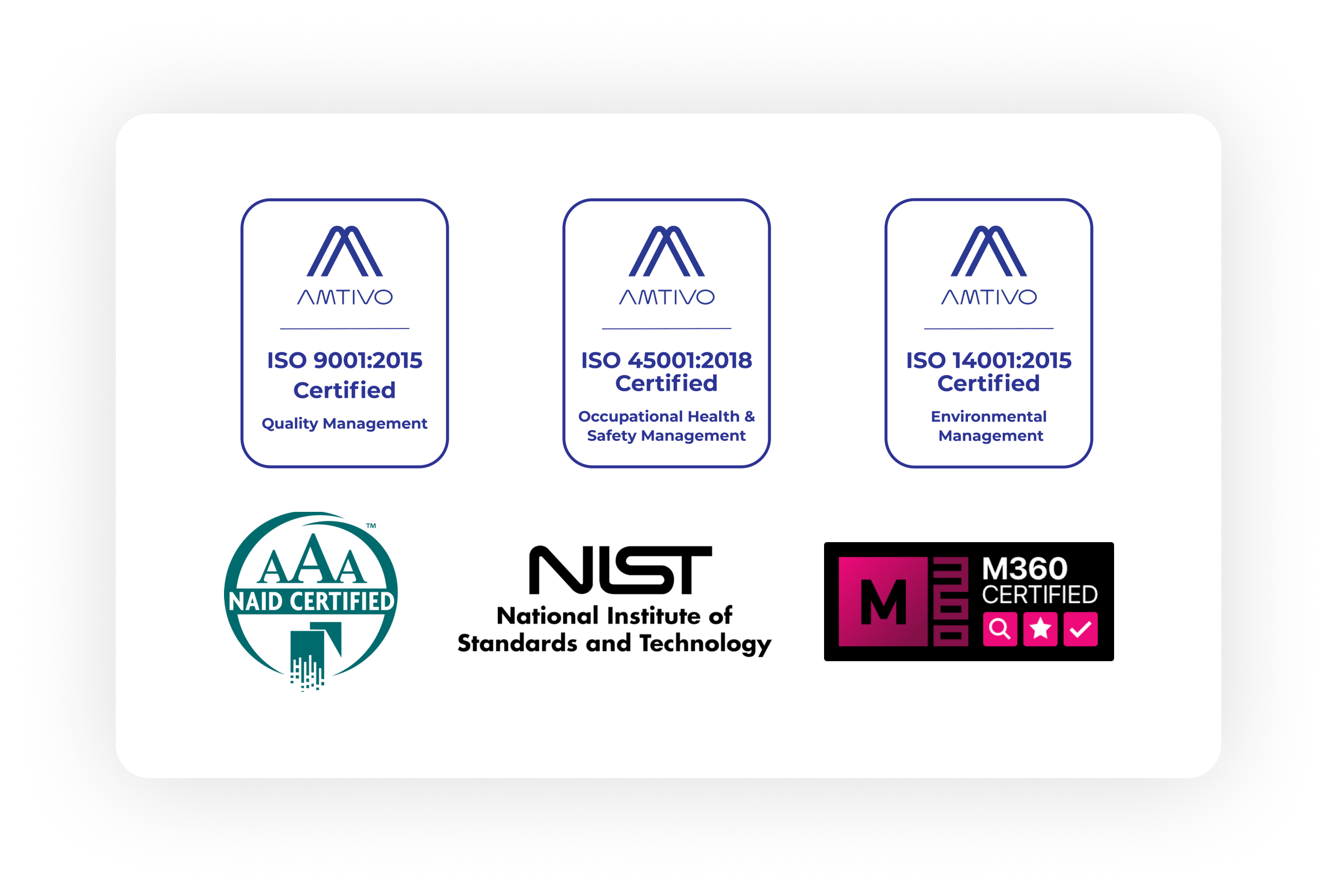
Our Certifications Ensure Your Peace of Mind

Technology Partners



How We Keep Your Data Secure
1
Secure Transportation & Storage
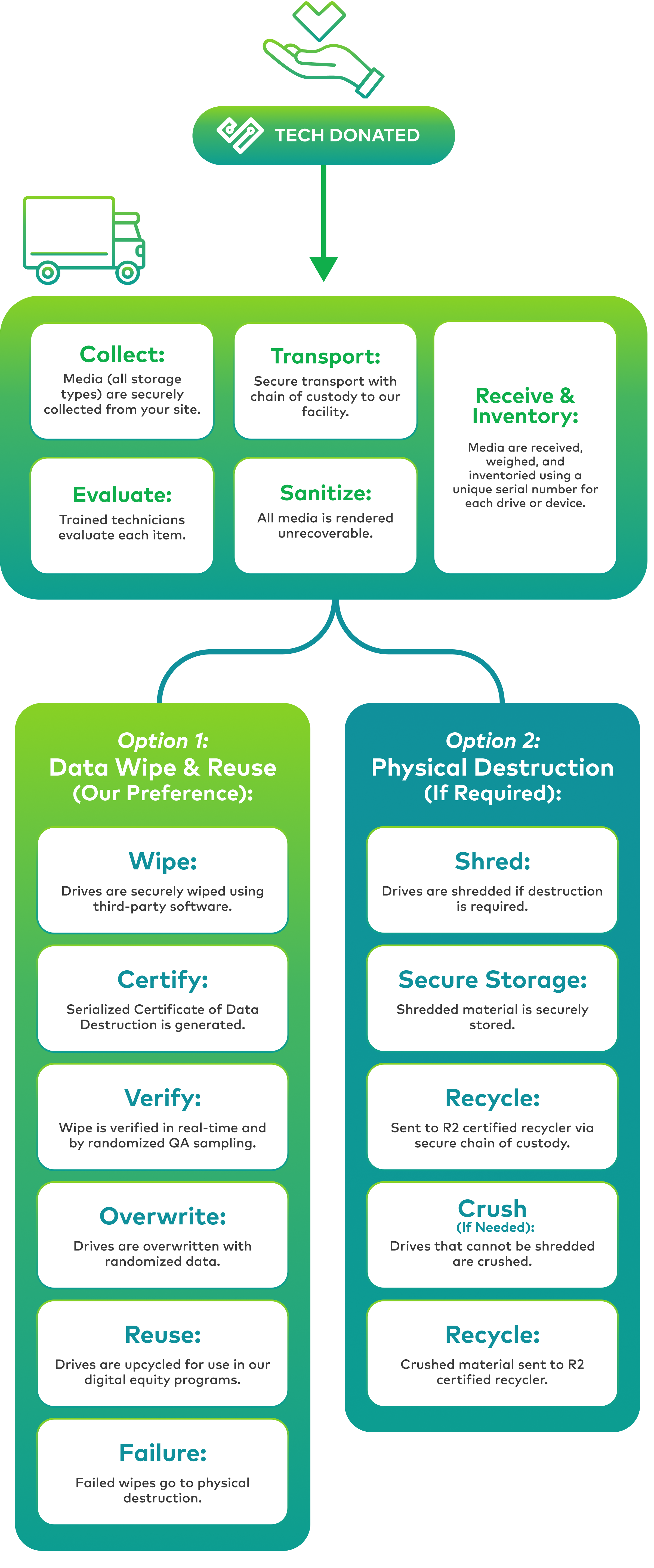
Devices with data storage are received by authorized Human-I-T personnel at a NAID-certified facility, or routed under chain of custody to an approved R2v3-certified downstream partner when appropriate for the device type or condition.
2
Comprehensive Data Sanitization
Using a NIST 800-88 method, random data is written through the entirety of the device with data storage in order to destroy all recoverable data on the device. The device with data storage is then re-scanned to verify that 100% of all sensitive information has been destroyed.
3
Physical Destruction
Devices or media that cannot be wiped or physically destroyed in-facility may be routed under chain of custody to approved R2v3-certified downstream partners, whose certifications include data security requirements.

Providing you assurance with comprehensive verification
We take extra steps so you don’t have to. Because we understand that with all your other difficult job responsibilities, direct oversight of tech disposal shouldn’t have to be one of them.
Contact Us for Secure Data Destruction

Certifies that data-bearing items listed in the report have been sanitized, physically destroyed, or sent to an approved downstream sanitization partner, in accordance with the disposition path appropriate to each item type.
A serialized PDF report of all devices with data storage that had their data sanitized to show you things like the items’ serial numbers, their Human-I-T donation IDs, and the date they were each received

Report covering devices with data storage that were physically destroyed in-facility, including serial number, destruction method, and technician name. Note: small media such as USB drives, optical discs, and tapes are physically destroyed as a category without individual serial-level reporting.
What reporting you'll receive
Donations are diverse, so our reporting reflects reality:
- Individually inventoried items (laptops, desktops, tablets, servers, monitors, hard drives, and similar) are tracked with make, model, and serial number where available.
- Bulk materials (mixed cables, small peripherals, general e-waste) are reported in aggregate by category and weight.
- Small media (USB drives, optical discs, tapes) are securely destroyed as a category without individual serial-level reporting.
- Data-bearing devices follow one of three secure disposition paths: (1) NIST 800-88 wipe at our NAID AAA-certified facility, (2) physical destruction, or (3) chain-of-custody transfer to an approved R2v3-certified downstream partner whose own certifications include data security requirements.
Every donation that contains data-bearing devices receives a Certificate of Data Destruction. Additional serialized wipe reports and physical destruction reports are available on request and are generated based on the disposition paths used for your specific donation.
The Chain of Custody
An easy, no-hassle experience from start to finish

Human-I-T Secure Pickups
Your donations are transported securely in either Human-I-T’s GPS-tracked trucks with four cameras, or by one of our partners. Either way, the safety of your tech is guaranteed. You can also access Human-I-T truck live feeds and up to two months of recorded footage for complete peace of mind.

Shipped Donations
Enjoy the assurance of real-time tracking for all shipped donations, whether by parcel or freight, keeping you informed every step of the way.

Prepaid Laptop Boxes
For laptop-only donations, we offer secure, padded laptop boxes, making it convenient and safe to send your items to us.
Facility Security
Our facility is NAID- and ISO-certified, featuring advanced ADT security and rigorous background checks for all staff, ensuring the highest level of protection for your donated items.
What sets our services apart?
Have questions?
Ready to get rid of your tech?
Fill out the form below to speak directly with a member of our team!

What our certifications mean for you:
NAID AAA
NAID AAA means that a company has been verified by the National Association of Information Destruction (NAID) to meet strict standards for information destruction. NAID certification is a voluntary program administered by i-SIGMA that verifies secure information destruction practices through rigorous scheduled and unannounced audits, helping organizations protect sensitive data and avoid security breaches, fraud, and compliance penalties.
ISO 90001
ISO 9001 is an international standard that defines the requirements for implementing and maintaining a quality management system (QMS), helping organizations improve their performance and meet customer expectations.
ISO 14001
ISO 14001 is a set of standards that helps organizations reduce their environmental impact by establishing an effective environmental management system (EMS).
ISO 45001
ISO 45001 is the international standard for occupational health and safety management systems that helps organizations improve workplace safety and reduce risks. Organizations use it to demonstrate legal compliance, reduce incidents and absenteeism, while improving productivity, insurance costs, and employee morale.
M360
M360 is a mobile diagnostics and utility software that is certified by ADISA as a reliable software for data erasure. This certification ensures that M360 can securely and permanently erase data.
We are compliant with the following laws:
HIPAA
Data Security for Health Plans, Health Care Clearinghouses, and Health Care Providers
HIPAA, the Health Insurance Portability and Accountability Act, sets the standard for protecting sensitive patient data. Any company that deals with protected health information (PHI) must ensure that all the required physical, network, and process security measures are in place and followed.
Workstation and Device Security. A covered entity must implement policies and procedures to specify proper use of and access to workstations and electronic media. A covered entity also must have in place policies and procedures regarding the transfer, removal, disposal, and re-use of electronic media, to ensure appropriate protection of electronic protected health information (e-PHI).
GLBA
Data Security for Banks and Financial Institutions
The Gramm-Leach-Bliley Act requires financial institutions – companies that offer consumers financial products or services like loans, financial or investment advice, or insurance – to explain their information-sharing practices to their customers and to safeguard sensitive data. Specifically, human-I-T helps assist Banks, Credit Unions and other companies adhere to the Federal Trade Commission’s (FTC’s) Disposal Rule. Where applicable, the GLBA requires that customer information is disposed of in a secure way.
FACTA
Data Security for Credit Institutions and Reporting Agencies
The Fair and Accurate Credit Transaction Act of 2003 (FACTA) added sections to the federal Fair Credit Reporting Act (FCRA, 15 U.S.C. 1681 et seq.), intended primarily to help consumers fight the growing crime of identity theft. Accuracy, privacy, limits on information sharing, and new consumer rights to disclosure are included in FACTA.
FISMA
Data Security for Federal Executive Branch Civilian Agencies
FISMA requires federal agencies to implement a mandatory set of processes and system controls designed to ensure the confidentiality, integrity, and availability of system-related information. The processes and systems controls in each federal agency must follow established Federal Information Processing Standards, National Institute of Standards and Technology standards, and other legislative requirements pertaining to federal information systems, such as the Privacy Act of 1974.
PIPEDA
Data SEcurity for Private SEctor Organizations and Commercial Activity
The Personal Information Protection and Electronic Documents Act (PIPEDA) sets out ground rules for how private sector organizations may collect, use or disclose personal information in the course of commercial activities. PIPEDA also applies to federal works, undertakings and businesses in respect to employee personal information. The law gives individuals the right to access and request correction of the personal information these organizations may have collected about them.
SOX
Data Security for Public Companies and Financial Reporting
The Sarbanes-Oxley Act of 2002 (SOX) mandated a number of reforms to enhance corporate responsibility, enhance financial disclosures and combat corporate and accounting fraud. It created the “Public Company Accounting Oversight Board,” also known as the PCAOB, to oversee the activities of the auditing profession.
FAQs
What is the Human-I-T data sanitization process?
We sanitize data-bearing devices at our NAID-certified facilities where feasible; devices that cannot be sanitized in-facility are physically destroyed or routed to approved R2v3-certified downstream partners.
What data security certifications does Human-I-T have?
We are NAID AAA Certified. More specifically, this certification recognizes that our facilities passed rigorous, unannounced audits by the National Association of Information Destruction to ensure every element of our data security and destruction practices.
What type of data destruction reporting does Human-I-T provide?
Donations containing data-bearing devices receive a Certificate of Data Destruction. For added reporting, we also offer Data Sanitization Wipe Reports and Physical Destruction Reports covering in-facility disposition paths.
Ready to start making an impact with your technology or have more questions?
Please provide your information here and a Human-I-T representative will be in touch in 1 business day.