
Table of Contents
- TL;DR
- Introduction
- How Many Americans Still Lack Internet Access?
- How Does Broadband Access Affect Employment?
- What Programs Help Low-Income Families Get Online?
- Why Is Digital Literacy Just as Important as Access?
- FAQ
TL;DR
Roughly 23.9 million people in the United States still don’t use the internet—and the overwhelming reason isn’t a lack of infrastructure. It’s cost. Broadband access directly impacts employment, healthcare, and education outcomes for working families, yet millions remain priced out. Human-I-T provides low-cost internet, devices, and digital training to help income-qualified families get and stay connected.
Introduction
Nearly 24 million Americans started 2025 without internet access, according to DataReportal’s Digital 2025 report. That’s down dramatically from the 83.5 million who were offline in 2000—but it still represents millions of working families, students, and seniors cut off from job applications, telehealth, online banking, and basic government services.
The importance of high-speed broadband in the 21st century has become as critical as clean water was in the 19th century. It carries enormous socio-economic and health benefits for every community. Yet the digital divide persists—not because the infrastructure doesn’t exist in most areas, but because "affordable" plans simply aren’t affordable for the families who need them most.
The gap falls hardest on low-income households, communities of color, and rural populations. And it’s not shrinking fast enough on its own.
How Many Americans Still Lack Internet Access?
About 6.9% of the U.S. population—roughly 23.9 million people—did not use the internet at the start of 2025, according to DataReportal. At the household level, approximately 8 million U.S. households (6%) lack broadband internet at home, per Reviews.org.
That’s real progress from 15 years ago, when tens of millions more were disconnected. But progress measured in percentages obscures the human cost. Eight million households means millions of children who can’t do homework online, single parents who can’t apply for jobs after hours, and seniors who can’t access telehealth visits.
The digital divide doesn’t hit randomly. It tracks along income, race, age, and geography—reinforcing the same inequities that broadband access is supposed to help overcome.
How Does Broadband Access Affect Employment?
Internet access is one of the most concrete predictors of whether an unemployed person finds work. A 2016 Council of Economic Advisers (CEA) brief found that unemployed workers in households with internet were 4 percentage points more likely to be employed one month later than those in households without it. More recent research confirms the relationship: a study cited by the Urban Institute found that broadband adoption increased the employment rate by 0.87 percentage points at the community level.
Those numbers translate directly into paychecks, stability, and upward mobility.
The stakes go beyond individual job seekers. As Eileen Harris, Development Director at Human-I-T, has noted, "the STEM workforce now needs diversity—more representation of minorities across the board." When low-income communities lack internet access, they’re locked out of the very industries that drive economic growth. The talent pipeline narrows, and entire communities miss the on-ramp to higher-paying careers.
With remote work now a permanent feature of the labor market, broadband isn’t a luxury for working families. It’s infrastructure for survival.
What Programs Help Low-Income Families Get Online?
Several federal, local, and nonprofit programs exist to bridge the gap—but navigating them can be its own barrier.
ConnectHomeUSA
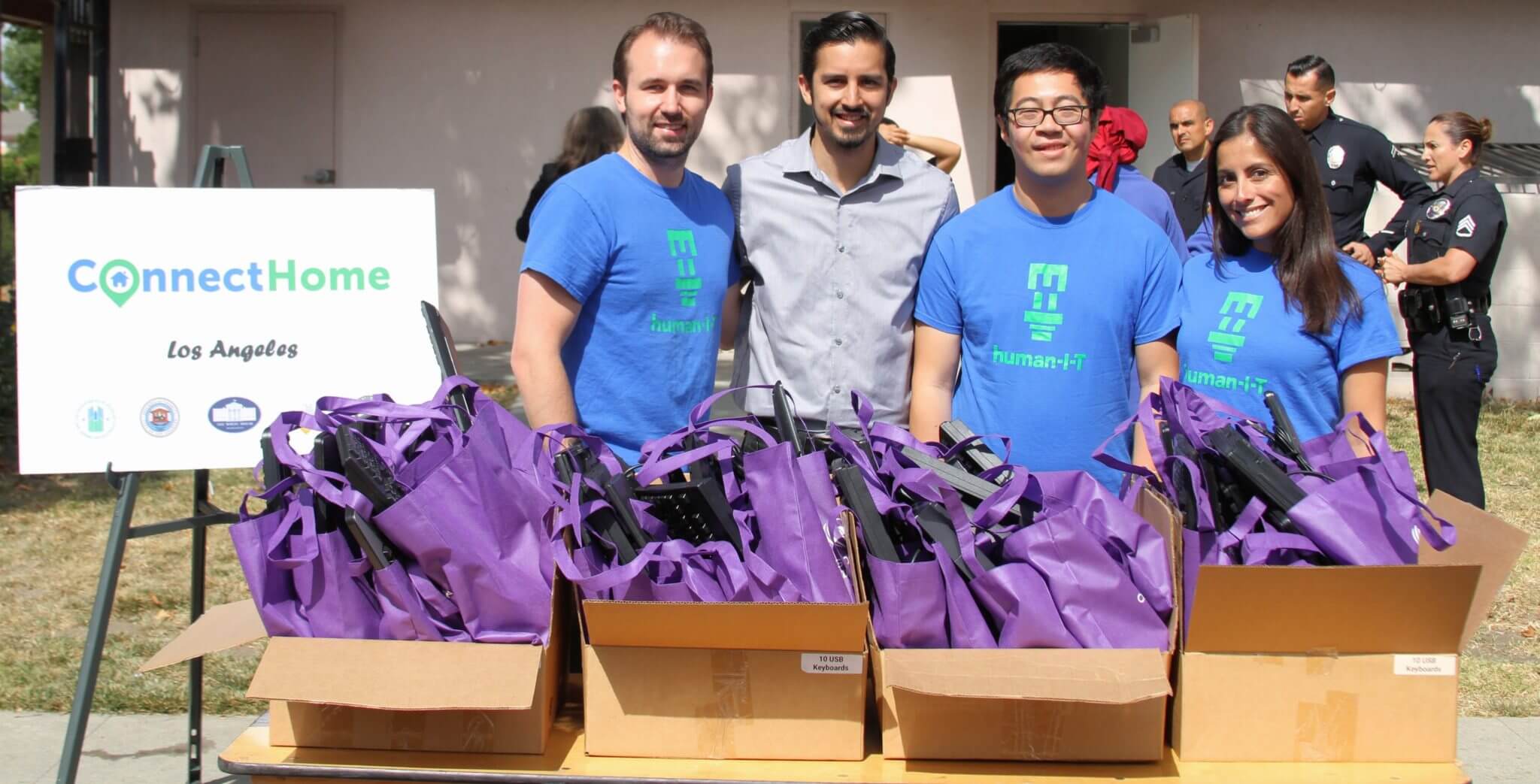
The U.S. Department of Housing and Urban Development’s ConnectHomeUSA initiative brings together communities, the private sector, and the federal government to expand broadband access to HUD-assisted families. The program launched as a pilot in 27 cities and one tribal nation, initially reaching over 275,000 low-income households, including 200,000 children. ConnectHomeUSA remains active in 2025, with ongoing webinar series helping participating communities connect households to broadband, low-cost devices, and digital skills training.
Human-I-T’s Low-Cost Internet and Device Programs
Human-I-T has long partnered with internet service providers and community organizations to ensure that income-qualified families can actually get online—not just in theory, but in practice. Our programs provide low-cost internet access, refurbished devices, digital literacy training, and ongoing tech support. That holistic approach matters. A cheap internet plan means nothing without a working computer, and a computer means nothing without the skills to use it.
These partnerships help families stay connected with distant relatives, fill out college applications, search for jobs, and access the economic opportunities most of us take for granted.
Why Is Digital Literacy Just as Important as Access?
Access without skills is a half-measure. As the CEA brief noted, digital literacy training is essential to "increase broadband adoption, ensuring that more Americans are able to take part in the digital economy, and share in its economic and social benefits."
Broadband-enabled telehealth, for example, can improve patient outcomes at lower cost and with a lower risk of infection than conventional in-person care. But those benefits only materialize when people know how to schedule a virtual appointment, navigate a patient portal, or troubleshoot a video call. The same applies to online banking, job portals, free educational courses, and bus schedules—tools that expand opportunity only for people who know how to use them.
That’s why Human-I-T doesn’t stop at handing over a device or activating a connection. We provide digital training and tech support because closing the digital divide means building confidence, not just providing cables.
The Power of Connection
Expanding internet access delivers measurable economic benefits: free online courses, job portals, networking opportunities, online banking, and civic engagement tools. As Lenni Montiel stated at a UN forum, the power of the internet "helps people connect, organize and act towards a common purpose."
That purpose now—as it was a decade ago—is to make sure everyone has the right to connect. The digital divide is closing, but not fast enough. And closing it demands more than laying fiber. It demands affordability, devices, skills, and sustained support.
FAQ
How many people in the U.S. don’t have internet access?
Approximately 23.9 million people in the United States did not use the internet at the start of 2025, according to DataReportal. At the household level, about 8 million U.S. households—roughly 6%—lack broadband at home.
Does having internet access actually help people find jobs?
Yes. Research from the Council of Economic Advisers found that unemployed workers with household internet access were 4 percentage points more likely to find employment within one month. The Urban Institute has cited additional research showing broadband adoption increases employment rates at the community level.
What is ConnectHomeUSA?
ConnectHomeUSA is a HUD initiative that partners with communities, the private sector, and the federal government to expand broadband access, low-cost devices, and digital skills training to HUD-assisted families. The program remains active in 2025, with ongoing webinars and community support.
How can I get low-cost internet and a computer for my family?
Human-I-T provides income-qualified families with low-cost internet, refurbished devices, digital training, and tech support—all in one place. No hidden fees, no confusing fine print. Check your eligibility and get connected today.
How can I donate technology to help close the digital divide?
Every donated laptop, tablet, or desktop that Human-I-T receives gets a second life—refurbished and placed with a family that needs it, keeping e-waste out of landfills and putting opportunity into homes. Fill out the technology donation form today.