
Editor’s Note: This article was originally published in 2023 and updated in October 2025 to reflect the latest Right to Repair legislation victories, current e-waste statistics, and emerging challenges like parts pairing. We’ve also expanded our guidance on how you can take action today.
TL;DR
Right to Repair laws reduce e-waste by requiring manufacturers to provide the parts, tools, and documentation consumers and independent shops need to fix devices instead of replacing them. The world generated 62 million metric tons of e-waste in 2022 — and only 22.3% was properly recycled — but seven US states have now passed Right to Repair legislation, with bills introduced in all 50 states. You can act now by choosing repair over replacement, buying refurbished, and donating old technology to Human-I-T instead of tossing it.
Table of Contents
- How Bad Is the E-Waste Crisis Right Now?
- What Is the Right to Repair Movement?
- How Does Repairing Devices Actually Reduce E-Waste?
- Why Do Manufacturers Make Devices So Hard to Fix?
- Which States Have Passed Right to Repair Laws?
- What Challenges Still Block the Right to Repair?
- How Does Human-I-T Support Repair and Reuse?
- What Can You Do to Reduce E-Waste Today?
- FAQ
Introduction
We find ourselves surrounded by electronics. Smartphones, laptops, tablets — these devices enhance our lives. But they come with a hidden cost. As they break or become outdated, they fuel a growing global crisis: electronic waste.
The Global E-waste Monitor 2024 reported a record 62 million metric tons of e-waste generated in 2022 — an 82% increase from 2010. Only 22.3% was properly recycled. The rest? Burned, dumped in landfills, or processed through informal channels that harm both people and the planet. Meanwhile, manufacturers keep gluing batteries in place, soldering components together, and using software to block independent repairs.
Enter the Right to Repair movement — a direct counter to the throwaway culture that corporations engineered. This initiative champions a simple idea: you should be able to fix what you own. According to PIRG, seven states have now passed Right to Repair legislation, and bills have been introduced in all 50 states. The path forward isn’t easy — industry opposition, legislative hurdles, and new technological barriers like parts pairing stand in the way. But with every challenge comes opportunity for change, innovation, and a more sustainable future.
How Bad Is the E-Waste Crisis Right Now?
Global E-Waste by the Numbers
Bad — and getting worse. According to The Global E-waste Monitor 2024, the world generated 62 million metric tons of e-waste in 2022, an 82% increase from 2010. UNITAR projects that figure will reach 82 million metric tons by 2030 — a 32% jump from 2022 levels. E-waste is rising five times faster than documented recycling efforts.
Only 22.3% of that e-waste was properly collected and recycled in 2022. The rest gets burned, dumped, or processed through informal channels that harm both people and the planet.
The economic loss is staggering. The Global E-waste Monitor reports that improper e-waste management cost the global economy $37 billion in 2022. Meanwhile, $91 billion in valuable materials — including copper, gold, and rare earth elements — are lost annually because we’re not recycling effectively.
Why America Leads in E-Waste Generation
The United States plays an outsized role in this crisis. Americans generate some of the highest per-capita e-waste rates globally. Our consumption habits, short product life cycles, and limited repair infrastructure all contribute.
The issue is environmental and personal. Every broken laptop that gets tossed, every smartphone replaced because a cracked screen seemed impossible to fix — these decisions add up. They drain wallets and damage entire ecosystems.
What Is the Right to Repair Movement?
The Origins: From Conflict to Advocacy
The Right to Repair movement is a coalition of independent repair shops, environmental activists, and consumers fighting for legislation that guarantees access to the parts, tools, and information needed to fix devices. It emerged from frustration — starting around 2013, independent repair providers found themselves increasingly blocked as manufacturers stopped supplying parts, tools, and even firmware access. A practical problem evolved into a full-scale advocacy effort.
The Repair Association formed to unite these voices. The movement centers on three fundamental rights:
- Access to parts. Manufacturers should sell replacement components to anyone — not just authorized repair centers.
- Access to tools. Specialized repair equipment shouldn’t be locked behind corporate walls.
- Access to information. Repair manuals, diagnostic software, and technical documentation should be freely available.
These demands aren’t revolutionary. They’re about restoring something we used to take for granted: the ability to fix what we own.
How Does Repairing Devices Actually Reduce E-Waste?
Extending Device Lifespan Saves Resources
Directly — by attacking the root cause of e-waste: premature disposal. When devices can be repaired, they last longer. Longer-lasting devices mean fewer new products manufactured. Fewer products manufactured means less resource extraction, less energy consumption, and less waste.
The math is simple but powerful. According to The Repair Association, American households could save an average of $330 annually by repairing phones, computers, and appliances instead of replacing them.
The Economic Case: Repair vs. Replace
A cracked iPhone screen repair at an independent shop? Around $100-150. A new iPhone? $800-1,200. That’s money staying in your pocket and a functional device staying out of the landfill.
The US Public Interest Research Group found that consumers could collectively save billions by choosing repair over replacement. These savings matter most for working families and single parents who can’t afford to constantly upgrade.
Success Story: Patagonia’s Repair-First Model
Some companies already get it. Patagonia built their entire business model around repairability. Their Ironclad Guarantee covers repairs for any damage. They provide free DIY repair tutorials. They advocate for Right to Repair legislation.
The result? Products that last decades instead of years. Customers who become brand loyalists. A business model that’s both profitable and sustainable. Patagonia proves that repairability is good for the environment — and for business.
Why Do Manufacturers Make Devices So Hard to Fix?
How Companies Design for Disposal
Because planned obsolescence drives repeat purchases. Many companies design products to fail — or at least to become obsolete quickly.
It takes many forms: batteries glued into place, components soldered together, software updates that slow down older devices, designs that make simple repairs impossibly complex. The shift from modular, repairable products to sealed, disposable units happened gradually. But the impact has been massive. Consumers now expect to replace rather than repair. The throwaway culture has become normalized.
These aren’t oversights. Companies deliberately engineer short product lifespans to extract maximum profit.
The Real Cost of "Throwaway Culture"
This disposable mindset has consequences. Electronic devices contain hazardous materials — lead, mercury, cadmium. When these devices end up in landfills, these toxins leach into soil and water.
E-waste makes up only 2% of landfill mass but accounts for 70% of toxic waste. That’s a disproportionate environmental impact we can’t ignore.
Manufacturing new devices also requires immense resources — mining rare earth elements, shipping materials globally, energy-intensive production processes. Every premature replacement multiplies this environmental toll.
Which States Have Passed Right to Repair Laws?
State-Level Legislative Victories
The tide is turning. According to PIRG, seven different states have now passed a total of nine versions of Right to Repair legislation since 2020, with roughly 50 bills filed or carried over in 2025. According to iFixit, Right to Repair bills have now been introduced in all 50 US states. In 2025 alone, over 40 bills in at least 20 states have been proposed or passed.
Here’s how the wave built:
New York led the way. The state’s Digital Fair Repair Act took effect in December 2023, becoming the first state-level electronics Right to Repair law in the nation.
California followed with its Right to Repair Act (SB 244), signed by Governor Gavin Newsom in October 2023 and effective July 1, 2024. The law covers electronics and appliances sold for $50 or more, requiring manufacturers to provide parts, tools, and documentation for at least three to seven years after production.
Minnesota passed its Digital Fair Repair Act, also effective July 1, 2024, applying broadly to digital electronic equipment sold or used after July 1, 2021.
Oregon made history in March 2024. Governor Tina Kotek signed a Right to Repair bill that became the first in the nation to explicitly ban "parts pairing." The law took effect January 1, 2025.
Colorado continued the momentum with HB 1121, signed May 28, 2024, taking effect January 1, 2026.
While details vary, these laws share common requirements:
- Manufacturers must provide parts, tools, and documentation to independent repair providers and consumers on "fair and reasonable" terms.
- Parts and information must remain available for several years after a product stops being manufactured (typically 3-7 years depending on price).
- Manufacturers cannot use contractual clauses or technical measures that obstruct repairs.
- State attorneys general have enforcement authority, with penalties ranging from $1,000 to $5,000 per violation per day.
Right to Repair laws are separate from state e-waste disposal laws.
What Challenges Still Block the Right to Repair?
Parts Pairing: The New Barrier to Repair
Parts pairing — the practice of using software to "marry" components to specific devices — remains the single biggest threat to repair, even as legislation advances. Replace a screen or battery with a genuine part from another identical device, and features stop working. Warning messages appear. Functions get disabled.
iFixit calls parts pairing "the biggest threat to repair." In January 2024, they tested this on iPhones — swapping a battery from one iPhone to another, both genuine Apple products, triggered error messages claiming the battery wasn’t genuine.
Apple’s response has been mixed. In April 2024, the company announced changes allowing used genuine parts in iPhone 15 and newer models, introducing a "Repair Assistant" tool with iOS 18 for on-device parts calibration. But iFixit’s testing in October 2024 found the implementation "promising but flawed" — Face ID still wouldn’t calibrate properly, activation-locked parts remained unusable, and third-party parts continued to face restrictions.
The problem continues to evolve. As of 2025, independent repair technicians report that iOS updates continue to introduce new parts pairing restrictions, including screen pairing behaviors that trigger "Unknown Part" warnings after third-party replacements.
As Fight to Repair notes, "The practical consequences of that could be devastating for small, independent repairers."
Industry Opposition Continues
Manufacturers argue parts pairing protects security and safety. They claim opening up repairs could compromise user privacy or create safety risks. But consumer advocates push back — these concerns are overblown excuses to maintain repair monopolies and force consumers to buy new devices.
The Security Industry Association has raised concerns about Right to Repair’s impact on alarm systems and life safety equipment. Some industries have legitimate security considerations. But for most consumer electronics, the security argument doesn’t hold up. Patagonia manages to offer repairs without compromising product integrity.
Even laws on the books have weaknesses. Many include broad exemptions for game consoles, medical devices, commercial security equipment, and vehicles. These carve-outs, while sometimes justified, create gaps that leave millions of devices outside Right to Repair protections.
How Does Human-I-T Support Repair and Reuse?
Our Refurbishment Process
We live the Right to Repair philosophy every day. Since 2012, Human-I-T has transformed end-of-life technology into opportunities for working families and underserved communities. Our comprehensive refurbishment process extends device lifespans and keeps e-waste out of landfills.
Here’s how we do it:
- Collection. We partner with businesses to collect their outdated technology. Rather than sending functional equipment to recyclers who break it down for raw materials, we give devices a second life.
- Assessment. Our technicians evaluate every device — can it be refurbished? Does it meet quality standards? We’re selective. Only devices that can provide reliable service move forward.
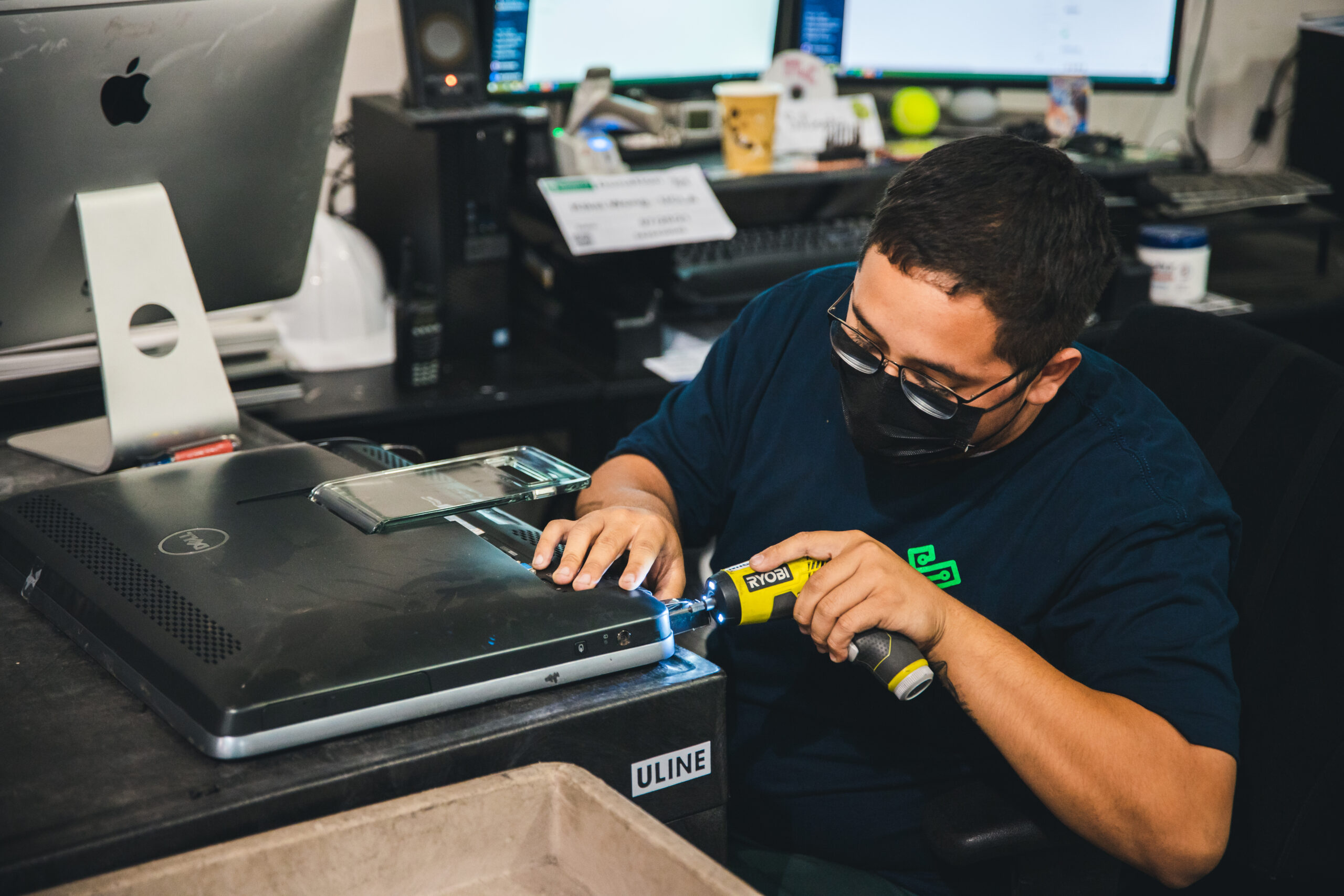
- Refurbishment. We repair, upgrade, and thoroughly test each device. New operating systems. Performance checks. Quality assurance. Every refurbished laptop, tablet, or desktop meets strict standards.
- Distribution. Refurbished devices go to people who need them most through our online store and community partnerships. Affordable technology for families. Digital inclusion for underserved communities. Sustainability in action.
The results speak for themselves: 434,000+ devices distributed, 15.1 million pounds of e-waste diverted from landfills, and digital literacy training provided to 11,500+ learners.
E-Waste Removal That Prevents Dumping
Not every device can be refurbished. Some are too damaged. Others are truly obsolete. That’s where our e-waste removal service comes in.
We provide secure, compliant disposal for businesses and individuals. NAID AAA certified data destruction. R2 certification. ISO standards compliance. Your data stays protected while devices are responsibly recycled.
What can’t be refurbished gets harvested for valuable components. Materials get recycled through certified partners. Nothing goes to landfills unnecessarily.
Creating a Circular Technology Economy
Human-I-T operates on a circular model that mirrors Right to Repair principles. We extend product lifespans through refurbishment. We make technology affordable and accessible. We handle end-of-life disposal responsibly.
This approach addresses both the e-waste crisis and the digital divide simultaneously. Corporate technology waste becomes someone’s opportunity to get online. Environmental sustainability meets social equity.
What Can You Do to Reduce E-Waste Today?
Support Right to Repair Legislation. Contact your state legislators — find out if Right to Repair bills are pending in your state and tell your representatives you support repair rights. The Repair Association and PIRG regularly organize petition campaigns. Add your name. Share your repair story — personal experiences resonate with lawmakers.
Choose Repair Over Replacement. Before buying new, explore repair options. Local repair shops can often fix devices for a fraction of replacement cost. Learn basic troubleshooting — many "broken" devices just need simple fixes. YouTube tutorials, iFixit guides, and manufacturer resources walk you through common repairs. And consider repairability before buying. iFixit publishes repairability scores for popular devices. Choose products designed to be fixed.
Buy Refurbished When Possible. Refurbished doesn’t mean inferior. It means tested, warrantied, and significantly cheaper than new. Human-I-T’s online store offers refurbished laptops starting at $130 — brand names like HP, Dell, and Apple, with income-qualified discounts available through our free Gold Membership.
Responsibly Recycle End-of-Life Devices. Wipe your data first. Don’t throw electronics in the trash — e-waste contains toxic materials that don’t belong in landfills. Donate your old technology to Human-I-T. We’ll ensure proper data destruction and responsible recycling.
Donate your tech to Human-I-T today — give your old devices a second life, keep e-waste out of landfills, and help close the digital divide. No gimmicks. Just real impact.
FAQ
Do Right to Repair laws actually reduce e-waste?
Yes. Right to Repair laws directly reduce e-waste by requiring manufacturers to provide the parts, tools, and repair documentation that keep devices in use longer. When consumers and independent shops can fix a cracked screen or replace a battery instead of tossing a device, premature disposal drops. According to The Repair Association, American households could save an average of $330 annually by repairing instead of replacing.
How many states have Right to Repair laws in 2025?
As of 2025, seven US states have passed Right to Repair legislation — including New York, California, Minnesota, Oregon, and Colorado. Right to Repair bills have been introduced in all 50 states, and over 40 bills in at least 20 states were proposed or passed in 2025 alone.
What is parts pairing and why does it matter?
Parts pairing is a manufacturer practice where software locks components to specific devices. Even if you swap a genuine part from an identical device, the replacement can trigger error messages or disabled features. Oregon became the first state to ban parts pairing in its 2024 law (effective January 2025), but the practice remains widespread — particularly with Apple products, where independent repair technicians continue to encounter "Unknown Part" warnings.
What can I do with old electronics I can’t repair?
Donate them to Human-I-T. We refurbish devices that still have life in them and distribute them to working families and underserved communities. For devices that are truly end-of-life, we provide NAID AAA certified data destruction and R2-certified responsible recycling. We’ve diverted 15.1 million pounds of e-waste from landfills and distributed over 434,000 devices.
Is buying refurbished technology reliable?
Absolutely. Certified refurbishers like Human-I-T thoroughly test, repair, and upgrade devices before resale. Our online store offers brand-name laptops starting at $130, with income-qualified discounts through our free Gold Membership. Buying refurbished saves you money, reduces demand for new manufacturing, and keeps functional technology out of landfills.