
If you’re looking for a 5G hotspot rental plan on a low income, here is the direct answer: true month-to-month hotspot rentals are rare, and the best one available in 2026 is a nonprofit rent-to-own plan — Human-I-T’s $24.99/month rental with unlimited 5G data, $0 upfront, and no credit check. If you can afford a one-time device purchase of between $50 and $65, nonprofit plans from Human-I-T ($14.99/month) and PCs for People ($15/month) are cheaper still. If you don’t meet income requirements, the strongest no-credit-check prepaid options run $25–$50/month.
This guide covers true rental and rent-to-own 5G hotspot programs, nonprofit subsidized plans, and no-credit-check prepaid alternatives — with total monthly costs, data limits, and eligibility requirements for each. It does not cover fixed home internet (fiber, cable, or 5G home gateways) or international travel hotspots, except to explain why to avoid them.
It’s written for people who already know they want a 5G hotspot, want to avoid a large upfront device cost, and need options that work on a tight budget — with or without a credit history.
Do true 5G hotspot rental plans actually exist?
Genuine ongoing-use hotspot rentals are rare. Most products marketed as “hotspot rentals” are short-term travel gadgets priced by the day, and no major carrier rents hotspots month to month anymore. The one true exception is the nonprofit rent-to-own model — a monthly device fee bundled with a data plan at $0 upfront — and that is the category to pursue.
To define the term: a hotspot rental plan is a connectivity arrangement that bundles a monthly device fee with a data plan, so you pay nothing upfront for hardware. Almost nothing on the commercial market actually fits that definition.
Travel rentals are financially punishing for ongoing use. Commercial rental services like Travelers WiFi charge roughly $7.50–$10.75 per day for a device with a 1GB–10GB daily data cap that hard-throttles to unusable 3G speeds once you hit it. Add $10–$30 in shipping fees and a roughly $140 penalty if the device is lost, damaged, or returned late. Used continuously, that works out to roughly $225–$320 per month — ten times the cost of a nonprofit plan.
Carriers no longer rent hotspot equipment monthly. T-Mobile, Verizon, and AT&T abandoned the legacy $10–$15/month equipment rental fee model. They now bundle equipment into the service price and enforce non-return penalties instead — $150–$200 at AT&T and up to $370 at T-Mobile if you cancel and don’t send the gateway back. So the “carrier hotspot rental” most searchers imagine simply doesn’t exist in 2026.
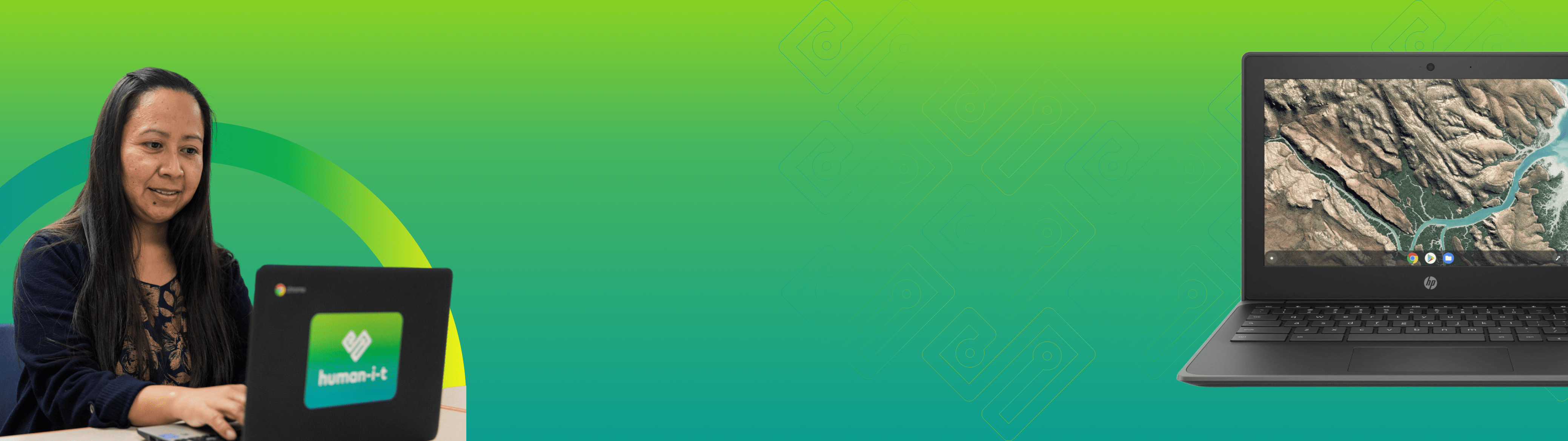
The real answer is the nonprofit rent-to-own model. Human-I-T offers unlimited 5G data plus the hotspot device for $24.99/month total with $0 upfront — no credit check, no contract, and hardware replacement included. It’s the leading example of the model, detailed in the next section.
Which nonprofit programs offer the cheapest 5G hotspot plans for low-income households?
For eligible households, nonprofit subsidized programs — not commercial carriers — deliver the lowest total cost. The three to know are Human-I-T, PCs for People, and Mobile Beacon, all running unlimited data on the T-Mobile network for $10–$25/month. Commercial standalone data plans, by comparison, average nearly $1 per gigabyte on their upper tiers.
Human-I-T — $14.99/month (own the device) or $24.99/month all-in rental. Human-I-T provides unlimited, unthrottled 5G data on the T-Mobile network for a flat $14.99/month if you purchase the hotspot outright (about $75–$89.99). Or choose the rental model: $24.99/month total with zero upfront cost, which includes hardware replacement if the device fails. There are no credit checks, no contracts, no cancellation fees, and no data throttling caps — and plans come bundled with free digital literacy training and bilingual tech support.
PCs for People — $15/month, but you must buy the device first. Through its Mobile Beacon partnership, PCs for People offers unlimited data on the T-Mobile network for $15/month (or $156/year prepaid, about $13/month), with no credit check. The key difference from a true rental: a device purchase of roughly $60–$150 upfront is mandatory — bring-your-own-device isn’t permitted — and data is deprioritized on congested towers after 100GB in a billing cycle.
Mobile Beacon — $10/month, but only through a partner organization. Mobile Beacon provides unlimited T-Mobile data at $10/month per device, but it’s a wholesale program sold to schools, libraries, and 501(c)(3) nonprofits — not directly to consumers. Ask your school, library, or a local nonprofit whether they partner with Mobile Beacon; if they do, you may be able to get a device through them.
The Calyx Institute — no income requirements, but $750 the first year. Calyx offers unlimited, unthrottled data with a premium 5G device (the Inseego MiFi Pro M4) as a membership benefit — but the Sustainer membership costs $750 the first year ($500/year after). There’s no income eligibility test, which makes it a fallback for households that miss the thresholds below, not a first choice for this audience.
If you think you qualify, see Human-I-T’s low-cost internet plans and check your eligibility.
How do you qualify for low-income hotspot programs, and what proof do you need?
The qualification standard is nearly universal: household income below 200% of the Federal Poverty Line, OR enrollment in a government assistance program — SNAP, Medicaid, SSI, Lifeline, or Section 8 Housing all qualify at both Human-I-T and PCs for People. (Human-I-T’s full accepted-program list also includes WIC, SSDI, TANF, NSLP, Head Start, and VA benefits.)
What does 200% of the Federal Poverty Line mean in dollars? Based on the 2026 federal poverty guidelines that Lifeline publishes for the contiguous U.S. ($21,546/year for one person and $29,214 for two at Lifeline’s 135% threshold), 200% FPL works out to roughly $31,900/year for a one-person household and $43,300/year for two people. For larger households, check the current guidelines table on the HHS poverty guidelines page — the threshold rises with each additional member.
What documents are accepted? The two major programs differ, so match your paperwork before applying:
- Human-I-T accepts benefit award letters only — member or enrollment cards alone are not accepted — and documents must be dated within the last 6 months, with the benefit active when you apply. For the income path, submit a prior-year state, federal, or Tribal tax return showing dollar amounts and household size; pay stubs are not accepted. You’ll also need a photo ID showing your address. You can apply online, by text, email, phone (1-888-391-7249), or in person, and the rental application page says verification takes about two minutes once your documents are in.
- PCs for People accepts proof of enrollment dated within the last 12 months (or showing current coverage) plus a photo ID, per its eligibility page. Not accepted: handwritten documents, pay stubs or W-2s, bank statements, Medicare cards, EBT app screenshots, or tax returns where you’re claimed as a dependent. Eligibility must be re-proven yearly; approval turnaround isn’t published, and staff may request additional documents.
Is the paperwork worth it? Yes, decisively. Commercial standalone data plans average nearly $1 per gigabyte on upper tiers, while nonprofit unlimited plans run $14.99–$24.99/month flat. Against the cheapest comparable prepaid option ($50/month for a capped 100GB — see the next section), the $24.99 all-in rental saves about $300 a year while removing the data cap entirely.
Ready to apply? Start the application to get connected through Human-I-T.
What are the best no-credit-check prepaid hotspot plans if you don’t qualify for nonprofit programs?
If you miss the income thresholds, the best value in prepaid, no-credit-check hotspot data is $0.50 per gigabyte: Metro by T-Mobile’s 100GB plan and Straight Talk’s 100GB plan, both $50/month. If you already own a smartphone, BYOD plans from Visible and US Mobile drop the equipment cost to $0.
Applying the same criteria — monthly price, data cap, throttle policy, device cost — in order of value:
- Best per-GB value: Metro by T-Mobile and Straight Talk — $50/month for 100GB. Both hit $0.50/GB, the cheapest prepaid rate on the market. Metro throttles to 128 kbps after the cap and charges a $25 activation fee; Straight Talk hard-caps at 100GB and requires a $49.99–$99 router purchase upfront.
- Best if you own a smartphone: Visible $25/month or US Mobile $44/month. Visible’s base plan includes unlimited hotspot data perpetually capped at 5 Mbps — workable for email, browsing, and SD streaming. US Mobile’s Unlimited Premium includes truly unlimited, uncapped high-speed hotspot data for $44/month — one of the most robust tethering options at any price. Both are $0 equipment cost.
- Lightest use: T-Mobile Prepaid Mobile Internet — $10/2GB up to $50/50GB. Fine for occasional email and job applications, but the low tiers cost $3–$5 per GB, and you’ll need to buy a device outright (Franklin T10 at $90 or TCL Linkport IK511 at $96).
- Avoid the false bargains. Mint Mobile’s advertised $15/month requires $180 prepaid upfront and hard-caps hotspot use at 10GB/month. Boost Mobile charges a $10/month hotspot add-on on lower-tier plans. Both look cheap on the banner and cost more in practice.
What will a hotspot rental plan really cost per month — including the fees nobody advertises?
Over the first year, a nonprofit 5G hotspot rental is the cheapest zero-upfront path (~$300 all-in), the nonprofit purchase path is comparable if you have device money (~$240–$330), and prepaid carrier plans cost more than double (~$715+) for capped data.
| First-year cost | Human-I-T rental | PCs for People | Metro by T-Mobile prepaid |
|---|---|---|---|
| Service (12 mo.) | $24.99 × 12 = $299.88 | $15 × 12 = $180 | $50 × 12 = $600 |
| Device upfront | $0 (included) | $60–$150 (required) | ~$90 (typical prepaid hotspot) |
| Fees | $0 | $0 | $25 activation |
| First-year total | ~$300 | ~$240–$330 | ~$715+ |
| Data | Unlimited, unthrottled | Unlimited, deprioritized after 100GB | Hard 100GB cap, then 128 kbps |
Fee traps to check before signing anything:
- Carrier activation/connection fees: $25 at Metro, $35 per line at T-Mobile postpaid.
- Non-return penalties: $85 at some library lending programs, $150–$200 at AT&T, and up to $370 for a T-Mobile home gateway.
- Travel-rental loss penalties: roughly $140 at daily-rate rental services.
Which options carry zero contract exposure? Human-I-T has no contracts, no cancellation fees, and no credit checks — you can stop any month without penalty. Prepaid carrier plans generally carry no termination fees either, since you’ve already paid for the month. The lock-in risk lives in postpaid carrier accounts and device installment plans, not in the options recommended here.
Do advertised prices include taxes and fees? Visible’s pricing is confirmed tax-and-fee-inclusive. PCs for People describes its plans as prepaid with no hidden fees. For Metro and other prepaid carriers, check the FCC-mandated Broadband Consumer Label at the point of sale — providers are required to disclose every one-time and monthly fee — or confirm with the provider before your first payment.
Deciding between renting and buying? Compare hotspot devices and plans in the Human-I-T store.
Will a “cheap” hotspot rental plan actually handle your household’s internet use?
A capped plan can absolutely cover one person’s job applications, schoolwork, and email — but no 50GB or 100GB plan can replace home internet for a streaming-heavy family. The average U.S. household now consumes more than 767GB of data per month, according to OpenVault network telemetry, so match the plan to your real usage before you sign up.
Know the difference between the three kinds of limits:
- Hard cap/cutoff (most prepaid carrier plans): data stops or becomes unusable at the cap until the next cycle.
- Punitive throttle: speeds drop to 128 kbps (AT&T, Cricket) or 600 kbps (T-Mobile) after the cap — too slow for modern webpages, let alone video.
- Deprioritization (nonprofit unlimited plans): full speed most of the time; slows only on congested towers, typically after 100GB. This is the gentlest limit — PCs for People works this way, and Human-I-T advertises no throttling caps at all.
Translate speed caps into real use: 5 Mbps (Visible base, Straight Talk Platinum) handles email, browsing, and SD streaming but struggles with HD video calls. 15 Mbps handles 1080p streaming and remote-work video conferencing comfortably. Unthrottled plans handle anything a single household throws at them.
A quick self-assessment: HD video consumes up to 3GB per hour. Estimate your household’s weekly hours of video streaming and video calls: at roughly an hour of HD video a day, you’ll use ~90GB/month and a 100GB plan is already tight; at two or more hours a day, only an unlimited nonprofit plan (Section 2) makes sense. If your use is mostly job applications, schoolwork portals, and email, any option in Section 4 will hold up.
Need a screen to go with the connection? Pair your hotspot with a low-cost refurbished laptop or tablet.
What happened to free hotspot options — libraries, schools, Lifeline, and the ACP?
The free options you may remember are mostly gone. The ACP ended in 2024, the FCC’s 2025–2026 rulings ended federally funded library hotspot lending, and Lifeline’s mobile data minimum is too small to serve as a hotspot plan. Redirect your effort to the nonprofit and school programs that survived.
The ACP is gone; Lifeline can’t fill the gap. The Affordable Connectivity Program ended in 2024, taking its $30/month subsidy with it. The federal Lifeline program still exists ($9.25/month off broadband or bundled service), but the FCC froze its mobile broadband minimum standard at just 4.5GB/month through at least December 1, 2027. Since a single HD video stream can consume up to 3GB per hour, 4.5GB a month cannot function as a hotspot data plan — treat Lifeline as a bill discount, not a connectivity solution.
Library and school hotspot lending is collapsing. In September 2025 the FCC voted to eliminate E-Rate funding for off-premises hotspot lending and school bus Wi-Fi, finalizing the decision in January 2026. The fallout hit 1,762 public libraries and school districts nationwide: LA County Library phased out hotspot lending entirely by March 2026, and LAUSD lost an estimated $10–$12 million in support, affecting up to 70,000 students. Some programs survive on local funding — Chicago Public Library’s Internet to Go still lends T-Mobile hotspots for three weeks at a time — so call your library before counting on borrowing one, and expect waitlists.
Families with K-12 students still have live pathways. T-Mobile’s Project 10Million provides a free hotspot and 200GB/year of free high-speed data for five years to families with a student enrolled in NSLP, SNAP/EBT, CEP, Medicaid, or FDPIR — you apply directly through T-Mobile with proof dated within the past year, and verification runs through a 7-day document-review window. District-funded programs like Chicago Connected (free in-home broadband for roughly 100,000 eligible students) are also worth checking with your school district.
Will you actually get 5G speeds where you live — and does it matter?
Most low-income hotspot programs run on the T-Mobile network, so check T-Mobile coverage at your address before committing — and know that even a 4G/LTE fallback is enough for nearly every use case on this page.
Check the right carrier’s map. Human-I-T, PCs for People, and Mobile Beacon all run on T-Mobile’s network. Visible runs on Verizon. Cricket runs on AT&T. US Mobile lets you choose among all three networks. Verify coverage at your specific address using the FCC National Broadband Map (enter your address and view mobile coverage by carrier) and the carrier’s own coverage map — and remember that maps show estimated outdoor coverage, not guaranteed indoor signal. If you’re applying through a nonprofit, ask them to confirm coverage at your address before you commit; there’s no cancellation fee with Human-I-T if service doesn’t work out.
4G is fine for what most households need. Job applications, schoolwork portals, video calls, and HD streaming need roughly 5–25 Mbps — video conferencing and 1080p streaming run comfortably at 15 Mbps. A solid LTE connection typically clears that bar, and the refurbished 5G hardware nonprofits deploy (like the Inseego MiFi M2000) achieves 300+ Mbps on mid-band 5G networks — far more than typical household tasks require. Data limits, not the 5G-vs-4G distinction, are what will actually constrain you.
Decision framework: when to choose what
| Decision variable | Human-I-T (5G hotspot rental) | PCs for People | Prepaid carrier (Metro / Straight Talk) | Visible / US Mobile (BYOD) |
|---|---|---|---|---|
| Upfront cost | $0 | $60–$150 device purchase required | $50–$99 device + $25 activation (Metro) | $0 (uses your smartphone) |
| Monthly cost | $24.99 rental all-in / $14.99 with owned device | $15 ($13/month on annual plan) | $50 for 100GB | $25 (5 Mbps cap) / $44 (unthrottled) |
| Credit check required | No | No | No | No |
| Data limit | Unlimited, no throttling caps | Unlimited, deprioritized after 100GB | Hard cap at 100GB, then 128 kbps or cutoff | Unlimited (speed-capped) / unlimited unthrottled |
| Income eligibility required | Yes (<200% FPL or SNAP/Medicaid/SSI/Lifeline/Section 8) | Yes (<200% FPL or federal assistance) | No | No |
| Rule of thumb | Choose if eligible and you have $0 for a device or expect >100GB/month usage | Choose if eligible, can pay $60–$150 upfront, and want the lowest monthly bill | Choose only if ineligible for nonprofit programs and use under 100GB/month | Choose if ineligible, own a capable smartphone, and can live with 5–15 Mbps tethering |
Bottom line: if your household income is under 200% of the Federal Poverty Line or you receive SNAP, Medicaid, SSI, Lifeline, or Section 8, the nonprofit path wins on every variable — and if you don’t have $60–$150 for a device, the $24.99/month zero-upfront rental is the only true 5G hotspot rental plan built for ongoing use in 2026. Check your eligibility and get connected through Human-I-T.