

TL;DR
Digital equity isn’t a nice-to-have — it’s the foundation that every other form of social equity stands on. With 6.8 million U.S. households still lacking reliable internet access in 2025, the digital divide continues to block working families from education, employment, healthcare, and economic mobility. Donating devices and supporting organizations like Human-I-T directly closes this gap — one connection at a time.
Table of Contents
- What Is the Digital Divide, and Why Does It Block Social Equity?
- How Does the Digital Divide Undermine Education?
- Why Can’t We Achieve Economic Growth Without Digital Equity?
- What’s Stopping Us From Closing the Digital Divide?
- What Is Human-I-T Doing to Shrink the Digital Divide?
- FAQ
Introduction
America’s offline population has dropped from 27 million to roughly 7.9 million over the past decade. Progress — but not victory. Because the people still disconnected aren’t randomly distributed. They’re concentrated in low-income communities, communities of color, and rural areas where "affordable" broadband remains anything but. According to Forbes, 32% of Black households still lack a broadband connection at home — nearly double the 18% national average.
The digital divide isn’t a technology problem. It’s a mirror reflecting every inequity we claim to care about — in education, employment, healthcare, and civic participation. When classrooms operate online, when job applications live on portals, when doctors consult via video, being disconnected doesn’t mean being inconvenienced. It means being disenfranchised.
For many working families, single parents, and seniors, the lack of digital access dictates their life trajectory — and, by extension, the trajectory of society as a whole.
What Is the Digital Divide, and Why Does It Block Social Equity?
The digital divide is a barrier built from the same materials as every other systemic inequality: income, race, geography, and institutional neglect. At its core, it separates those with access to technology and the internet from those without. But more than that, it gates the opportunities, resources, and services that modern life increasingly demands.
Socioeconomic status is the most reliable predictor. Households with incomes below $30,000 are disproportionately affected, with a significant share lacking broadband internet access. That means fewer completed job applications, fewer telehealth appointments, fewer children keeping pace in school. Without digital access, a significant portion of our society isn’t just inconvenienced — they’re locked out of upward mobility entirely.
And this isn’t shrinking as fast as the headlines suggest. While the overall number of offline Americans has fallen, 6.8 million U.S. households still do not have reliable internet access in 2025, with a disproportionate 3.1 million of those in communities of color and rural areas. The divide persists because the forces creating it — digital redlining, hidden fees, corporate pricing structures — persist.
How Does the Digital Divide Undermine Education?
Education has always been positioned as the great equalizer. The digital divide makes that promise hollow for millions of students.
Technology isn’t a supplemental tool anymore — it’s the fabric of the modern educational experience. Students without digital access fall behind in ways that compound across years: they miss collaborative learning platforms, interactive simulations, vast digital libraries, and the development of digital literacy skills that the job market now treats as non-negotiable.
The absence of technology in a student’s life doesn’t create one gap — it creates many:
Academic development suffers when students are confined to potentially outdated physical resources while peers access global knowledge bases in real time. Skill-building stalls — digital literacy, critical thinking, and collaborative competencies all depend on regular technology use. Higher education pathways narrow because digital proficiency is now crucial for college applications, assessments, and interviews. Extracurricular engagement — from digital art to coding clubs — becomes inaccessible. Personal growth takes a hit when students can’t explore hobbies, connect with mentors, or seek guidance online.
The long-term societal implications are alarming. Students without digital access lag behind academically, which translates to fewer job opportunities, lower earning potential, and a perpetuation of generational poverty. This isn’t an educational gap. It’s an educational crisis that threatens to undermine the very promise of education as a tool for social equity.
And the damage extends beyond K-12. In today’s economy, lifelong learning is paramount. Online courses, webinars, tutorials, and professional forums are how working adults build new skills and pivot careers. Those without access are denied these opportunities for continuous growth — widening the divide year after year.
Why Can’t We Achieve Economic Growth Without Digital Equity?
Because broadband access is a barometer of economic vitality — not just a measure of internet connectivity. Regions with higher broadband penetration consistently see surges in entrepreneurial ventures, innovation, and job creation. The inverse is equally true: communities without reliable connectivity face stunted economic growth and missed opportunities at every level.
The ripple effect of digital access extends from the macroeconomic to the deeply personal. On an individual level, digital proficiency unlocks remote work positions with global corporations, gig economy roles, freelance opportunities, and access to job training programs. Digital literacy has become a cornerstone skill — from basic email communication to complex data analysis roles — and yet a significant portion of the population, especially among low-income families and seniors, remains digitally illiterate.
Healthcare access is now inseparable from digital access. 82% of patients now endorse telehealth as a care delivery model, and with the U.S. facing a projected physician shortage of up to 86,000 by 2036, telehealth will only become more essential. Communities without digital tools can’t access these services — compounding health disparities on top of economic ones.
During the COVID-19 pandemic, many Black and Hispanic families faced disproportionate challenges due to the lack of digital resources, exacerbating existing social inequalities. These weren’t temporary setbacks. The learning loss, the missed economic opportunities, the health outcomes — these consequences are still playing out years later.
The digital divide is not just a technological issue. It’s a multifaceted challenge that requires holistic solutions.
What’s Stopping Us From Closing the Digital Divide?
Cost. Infrastructure. And the expiration of the one federal program that was actually working.
The financial constraints of acquiring technology and broadband services extend beyond just the lowest income brackets. Device costs, coupled with monthly subscription fees, strain the budgets of middle-income families too — limiting their full participation in the digital world. In rural areas, infrastructure limitations compound the problem: broadband services are often unavailable or unreliable, making the lack of digital equity a widespread concern that transcends income levels.
The situation grew more urgent after the Affordable Connectivity Program (ACP) ended on June 1, 2024. That program helped one in six U.S. families afford internet service. Its expiration left millions of households — disproportionately in low-income and communities of color — without the subsidy that kept them connected. As of 2025, no equivalent federal successor program has fully replaced it, making broadband affordability a growing crisis.
The solution doesn’t rest solely with individuals. Community involvement plays a pivotal role. Grassroots initiatives, local organizations, and community-driven programs bridge the gap by offering resources, training, and support. Government policies that incentivize broadband expansion, subsidize technology costs for income-qualified families, and integrate digital literacy into educational curriculums can accelerate the shift toward digital equity.
What Can You Do Right Now?
Achieving a digitally equitable society is a collective endeavor. For those with the means, donating devices, sponsoring internet subscriptions, or volunteering to teach digital literacy makes a tangible difference. For professionals in the tech industry, mentoring, offering workshops, or developing accessible digital tools paves the way for equitable access.
But beyond tangible actions, fostering a mindset of inclusivity matters. Recognizing the digital divide, advocating for equitable policies, and championing the cause in personal and professional circles amplifies the message and stimulates collective action.
What Is Human-I-T Doing to Shrink the Digital Divide?
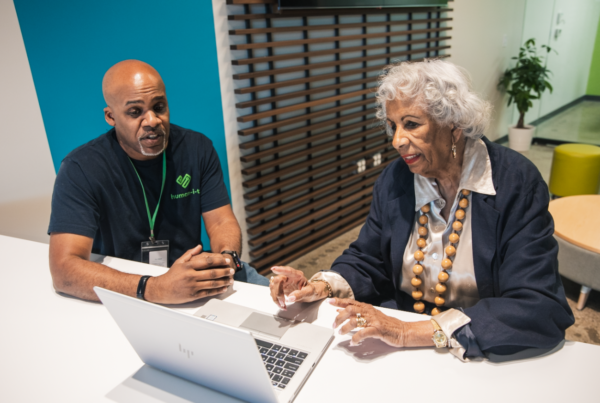
We provide the four pillars of digital inclusion — affordable devices, low-cost internet access, digital skills training, and tech support — because owning a device is just the first step. Understanding its potential and troubleshooting issues are equally crucial.
Collaborative Efforts That Work
A standout example is the partnership between Human-I-T and General Motors in Detroit’s Mexicantown. Together, we provided laptops to individuals served by Detroit nonprofit Southwest Solutions. The digital divide in Detroit is stark, with up to 30% of residents lacking internet access. The National Digital Inclusion Alliance ranked Detroit’s connectivity rate as the lowest nationally among large cities.
Recognizing this, Southwest Solutions and GM — with a $1.3 million grant — joined forces with Human-I-T. This partnership didn’t stop at sourcing laptops. Recipients were equipped with the skills and resources to use them effectively. We provide all laptop recipients with a one-year warranty and tech support because a device without support is a device that collects dust.
The Impact on Real Lives
One of the most powerful stories from the GM collaboration is that of Charles Montegue, a Detroit native and Air Force veteran who received a free laptop. For Charles, that laptop was a gateway — to video chatting with family spread across the globe from England to Japan, to consulting with his doctor remotely, and to watching his grandchildren’s playful antics in real time. These connections aren’t luxuries. They’re the basic fabric of a dignified life.
Our commitment is unwavering: we empower individuals and communities with the tools, skills, and knowledge they need to harness the power of digital platforms in their daily lives. Together — with the support of businesses, government partners, and communities — we can ensure that everyone has an equal opportunity to thrive.
Donate your technology today and take a direct step toward closing the digital divide. Or check your eligibility for low-cost devices and internet through Human-I-T.
FAQ
What is digital equity, and why does it matter for social equity?
Digital equity means every person has the technology, internet access, and skills needed to fully participate in modern life. Without it, working families are locked out of education, employment, healthcare, and civic participation — the very systems that social equity depends on. Digital equity isn’t a separate issue from social equity; it’s a prerequisite.
How many Americans still lack internet access in 2025?
According to Heartland Forward, 6.8 million U.S. households do not have reliable internet access in 2025, with 3.1 million of those in communities of color and rural areas. The overall offline population has dropped to roughly 7.9 million individuals, but those still disconnected face compounding barriers.
What happened to the Affordable Connectivity Program (ACP)?
The ACP — which helped one in six U.S. families afford internet — ended on June 1, 2024. No equivalent federal successor program has fully replaced it as of 2025, making affordability a growing crisis for low-income households that relied on the subsidy to stay connected.
How can I help close the digital divide?
The most direct action you can take: donate your old devices to Human-I-T. We refurbish technology and distribute it — along with low-cost internet, digital skills training, and tech support — to income-qualified families. You can also check your eligibility if you or someone you know needs affordable access.
How does the digital divide affect education specifically?
Students without technology access fall behind in academic achievement, miss digital literacy skill-building, lose access to collaborative learning platforms, and face narrower pathways to higher education. This educational lag translates to fewer job opportunities and lower earning potential — perpetuating cycles of poverty across generations.