
Last Updated: June 2025
TL;DR
Donating your old laptops, desktops, and tablets — instead of trashing or shredding them — puts working technology into the hands of families who can’t afford it while diverting hazardous e-waste from landfills. Despite near-universal internet penetration in the U.S., 13.3% of American households — 17.7 million — still lack a large-screen computer, according to 2024 American Community Survey data published by Digitunity. Donating your devices to Human-I-T gives them a second life and directly bridges that gap.
Table of Contents
- Why Does the Computer Ownership Gap Still Exist?
- How Does Refurbishing Electronics Help Families?
- What Happens to E-Waste When You Don’t Donate?
- How Does Donating Devices Work?
- FAQ
Why Does the Computer Ownership Gap Still Exist?
Because "connected" doesn’t mean "equipped." More than 93.1% of Americans use the internet in 2025 — that’s 332 million people, up by 51 million since 2015. Smartphone ownership has surged to near-universal levels, with 97% of adults under 50 and 90% of those over 50 now carrying one. On the surface, it looks like mission accomplished.
It’s not. A smartphone screen isn’t a substitute for a laptop when you’re writing a resume, completing coursework, or applying for jobs. According to the Benton Institute and Digitunity’s analysis of 2024 Census data, 1 in 7.5 U.S. households — 17.7 million — still don’t have a large-screen computer. That’s not a coverage problem. It’s an affordability problem, compounded by planned obsolescence that pushes families to buy new when functional devices sit in drawers and closets across America.
The digital divide in 2025 isn’t about whether the internet exists in your neighborhood. It’s about whether you have the right equipment to actually use it — to build digital literacy, access education, and open new paths to employment.
How Does Refurbishing Electronics Help Families?
It puts a working computer in the hands of someone who otherwise couldn’t afford one — and it does so without manufacturing a single new device.
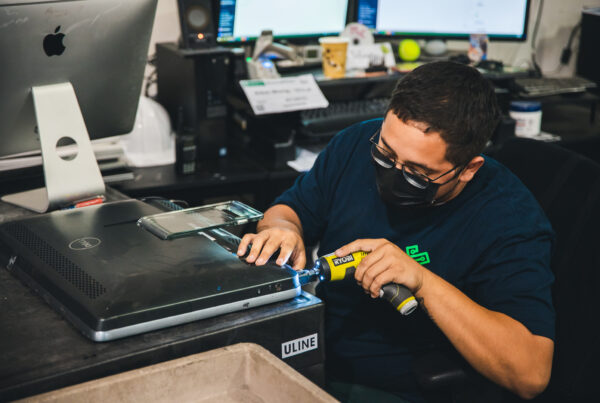
Human-I-T takes in donations of electronics from individuals and companies that believe in reusing devices. Our technicians refurbish them, wipe data securely, and distribute them to income-qualified families who experience a barrier to technology and internet access. This circular model means every donated laptop or desktop can become someone’s bridge to a better life.
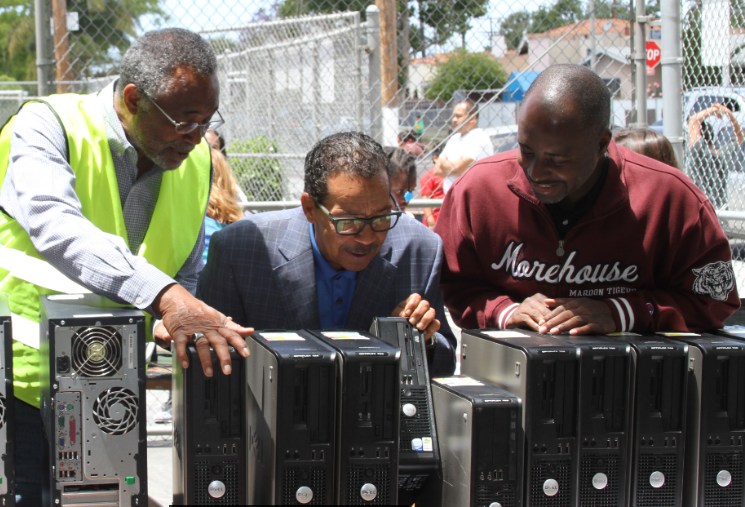
The impact is real and personal. Through our refurbishing and distribution events, we’ve helped people like Gary — a Navy veteran who used a refurbished computer to finish his university degree — and Patricia, who landed a job and enrolled at a local college after receiving a donated device.
When we mention numbers, remember: these are real humans. Not just statistics. Access to digital devices is a bridge to education, jobs, and connecting to family members. Every device donated is a second life — for the hardware and for the person who receives it.
What Happens to E-Waste When You Don’t Donate?
It ends up in landfills or gets shredded at recycling centers — both of which waste the remaining value inside that device.
We find ourselves surrounded by electronics. Smartphones, laptops, tablets — these devices enhance our lives. But they come with a hidden cost. When people rush for the newest smartphone or tablet, their old devices often get tossed. That’s hazardous materials leaching into soil and groundwater. It’s valuable resources being wasted. And it’s a missed opportunity to extend the lifespan of technology that still works.
Refurbishing old devices bypasses both landfills and shredders. It’s a circular approach — transforming what companies designed as a disposable product after a few years into a reusable tool. Human-I-T commits to up-cycle your electronics, aligning reused computers with potential recipients who don’t have sufficient funds to purchase one.
The alternative — more e-waste, more extraction, more pollution — isn’t just an environmental problem. It’s a digital equity problem. Every device shredded is a device that could have connected a working family to the internet.
How Does Donating Devices Work?
You donate. We refurbish. A family gets connected. It’s that direct.
Human-I-T accepts technology donations from individuals and companies. Our team evaluates each device, performs certified data destruction, refurbishes what’s viable, and distributes it to underserved communities through our programs and distribution events. This process allows us to reach more low-income families every day.
It’s becoming more imperative that we expand access to laptops and desktop-based computers so everyone can enjoy the benefits they offer — digital literacy skills training, new paths to jobs, and educational attainment. Donating your old electronics is one of the most tangible ways to make that happen.
FAQ
What types of electronics can I donate to Human-I-T?
Human-I-T accepts laptops, desktops, tablets, smartphones, and other electronics from both individuals and companies. Even if a device seems outdated to you, our technicians can often refurbish it for someone who needs it. Donate technology here.
How does donating electronics reduce e-waste?
When you donate a working or repairable device, it bypasses landfills and shredding entirely. Refurbishment extends the lifespan of electronics, keeping hazardous materials like lead and mercury out of the environment while giving the device a second life with a family that needs it.
Is the digital divide still a problem if most Americans are online?
Yes. While 93.1% of Americans use the internet in 2025, internet access via smartphone alone isn’t enough for education, job applications, or building digital literacy. 17.7 million U.S. households still lack a large-screen computer — the kind of device that actually enables full participation in the digital economy.
How can my company get involved with device donations?
Companies can donate surplus or decommissioned technology through Human-I-T’s secure ITAD services. We provide NAID AAA certified data destruction, responsible disposal, and a direct path to digital equity — your retired assets become someone’s first computer.
How do I get started?
Fill out the technology donation form today and take a step towards closing the digital divide while championing the cause of responsible e-waste management. No device is too old to make a difference.