
Businesses should dispose of lithium-ion batteries from old laptops and IT equipment by treating them as regulated hazardous waste from the day a device is decommissioned. Triage every battery as intact or damaged, store it under EPA Universal Waste rules, ship it by ground under DOT 49 CFR 173.185, and hand it only to a certified ITAD or recycler that documents chain of custody to final disposition.
This guide covers decommissioned laptops, tablets, and enterprise IT equipment, from storage through transport, vendor selection, and downstream recycling, for IT asset managers, facilities directors, EHS leads, and procurement teams. It does not cover EV packs, grid-scale storage, or household disposal.
Table of Contents
- Key Takeaways
- Why Can’t You Just Throw Lithium-Ion Batteries in the Trash or Standard Recycling?
- What Regulations Apply to Businesses Disposing of IT Batteries?
- How Should You Identify, Assess, and Triage Batteries Before Disposal?
- How Should You Store and Package Lithium-Ion Batteries On-Site Before Pickup?
- How Should Lithium-Ion Batteries Be Transported for Recycling?
- How Do You Choose a Qualified Battery Recycler or ITAD Vendor?
- What Happens to the Batteries After They Leave Your Facility?
- How Should Battery Disposal Integrate with Your Broader ITAD and Sustainability Programs?
- Decision Framework: In-House, Take-Back, or Certified ITAD?
- Frequently Asked Questions
- Retiring a laptop or IT fleet? Contact our team to receive secure, NAID AAA certified ITAD services that drive impact
Key Takeaways
You cannot put a spent laptop battery in the trash or the blue bin. According to EPA’s May 24, 2023 memorandum, most end-of-life lithium-ion batteries are hazardous waste for ignitability (D001) and reactivity (D003). Minnesota, New York, and California enforce explicit bans on top.
Your compliance path is the Universal Waste rule (40 CFR Part 273): one year of on-site storage in closed, labeled containers, no manifest, standard carriers, as long as the batteries stay intact.
Sort every battery as intact or damaged/defective/recalled (DDR) before it leaves your building. That call decides the container, the shipping rule, and whether your vendor accepts it.
Ship by ground under the 49 CFR 173.185(d) recycling exception. Air freight triggers IATA’s 30 percent state-of-charge mandate, which you cannot verify on a dead laptop.
Under CERCLA you own your hazardous waste from cradle to grave. Choose an R2v3 or e-Stewards certified vendor – or at least one like Human-I-T which works with vendors with R2v3 and e-Stewards certifications —that documents every downstream handoff and returns a Certificate of Recycling traceable to your serialized asset list.
Why Can’t You Just Throw Lithium-Ion Batteries in the Trash or Standard Recycling?
Because federal law classifies them as hazardous waste, and because they start fires. EPA’s May 24, 2023 memorandum determined that the vast majority of end-of-life lithium-ion batteries exhibit ignitability (D001) and reactivity (D003). Disposing of them in municipal solid waste or ordinary recycling violates RCRA. Several states add explicit landfill bans with their own penalties.
The physics first. Laptop pouch cells have no rigid casing. Puncture or crush one and the separator fails, dumping stored energy as heat in under 60 seconds. A cell in thermal runaway can exceed 600°C while venting hydrogen fluoride and carbon monoxide. One cell ignites its neighbors.
Then the money. Shoreway has logged 47 more fires since 2016, and management traces 95 percent of them to discarded lithium batteries. According to UL Solutions, recycling-related lithium battery fires rose 187 percent between 2020 and 2024. EPA’s July 2021 report attributed hundreds of waste-facility fires to lithium-ion batteries. Industry estimates put combined U.S. and Canadian losses above $1.2 billion.
Then the statutes: Minnesota’s § 115A.9157 and New York’s ECL § 27-1805 ban rechargeable batteries from garbage and solid waste, and California’s DTSC treats swollen units as immediate reactive hazards under its Hazardous Waste Control Law.
Throwaway culture built this: devices designed for a three-year life, batteries glued into chassis, no plan for what comes next. Recycling workers and municipal budgets pay the bill. And because neither EPA, NFPA, nor EREF separates IT battery fires from e-bike and EV fires, your carrier’s premiums are shaped by consumer micromobility failures, not by a pallet of ThinkPad batteries.
What Regulations Apply to Businesses Disposing of IT Batteries?
Four regulators touch a spent IT battery. EPA governs storage (RCRA and the Universal Waste rule, 40 CFR Part 273). DOT and PHMSA govern shipping (49 CFR 173.185). OSHA governs worker exposure (29 CFR 1910.1200). Local fire officials govern stored quantity (IFC 1207, NFPA 855). Universal Waste is your primary path, but your strictest state sets the standard.
The federal baseline
Without Universal Waste, every spent battery would be full RCRA Subtitle C hazardous waste (40 CFR Part 262): 90- or 180-day limits, manifests, specialized transporters. The Universal Waste rule lets you classify laptop, tablet, and UPS batteries as “Universal Waste – Batteries,” skip manifesting, use standard carriers (DOT rules still apply), and store for one year, provided the batteries stay intact and you never crush, shred, or otherwise treat them. Under 5,000 kilograms (11,000 pounds) of total universal waste on-site you are a Small Quantity Handler (SQHUW); at or above, a Large Quantity Handler (LQHUW). Same one-year limit either way.
The trap: state deviations
The rule is delegated to states, and states may go further. Battery management has fractured into a patchwork of up to 50 different standards. Three that catch multi-state programs:
| State | Rule | The trap for a fleet program |
|---|---|---|
| California | DTSC permits Universal Waste management but enforces the full Hazardous Waste Control Law against mismanagement; 22 CCR § 66273.35 | One-year clock runs from the exact date of generation, no leniency for undocumented storage; swollen units treated as immediate reactive hazards |
| New York | Universal Waste adaptations in 6 NYCRR 374-3; state battery law carves out large-format batteries | Mixing UPS rack batteries with laptop batteries risks defaulting the whole stream to 6 NYCRR Part 370 hazardous waste rules |
| Massachusetts | 310 CMR 30.000 | Dual liability on generators and haulers; discarded lithium-ion batteries are full hazardous waste unless routed to a Class C Regulated Recycler |
The new layer: producer-responsibility laws
| State | Statute | Effective | What it means for a commercial generator |
|---|---|---|---|
| California | SB 1215 (Covered Battery-Embedded Products) | January 1, 2026 | 1.5% recycling fee, capped at $15, at retail sale of products with non-removable embedded batteries. Battery disposition now shows up in procurement. |
| California | AB 2440 (Responsible Battery Recycling Act) | April 1, 2027 | Producer-funded stewardship for loose, user-serviceable batteries via approved PROs. Segregate embedded from loose batteries before ITAD handoff. |
| New York | ECL Article 27, Title 18 | December 10, 2010 (amended 2025) | Landfill ban. Retailers must accept up to 10 batteries per person per day, useless at fleet scale. Bulk disposal goes through manufacturer-funded plans or ITADs under approved DEC plans. |
| Washington | Chapter 70A.555 RCW (SB 5144) | January 1, 2027 (portable batteries) | Producers fund collection networks; commercial generators get free, continuous collection sites. |
| Minnesota | Minn. Stat. § 115A.9157 | Active (further EPR pending via HF 4565) | Explicit ban from mixed municipal solid waste; manufacturer collection programs you are expected to use. |
| Illinois | Public Act 103-0383 | Active | Directs the state agency to assess commercial generator stewardship, adding reporting expectations. |
Two caveats: these laws target producers and give generators thin enterprise-scale guidance, and Washington and Minnesota are still in rulemaking, so this table will age. Re-check it yearly.
How Should You Identify, Assess, and Triage Batteries Before Disposal?
Before any battery leaves your building, sort it as intact or damaged/defective/recalled (DDR). That classification determines how the battery must be stored, which DOT rule it ships under, and what your vendor needs to accept it. At minimum, run a visual inspection and a basic software diagnostic on every device.
Step-by-step triage
- Run a diagnostic. OEM tools (Dell SupportAssist, HP PC Hardware Diagnostics, Lenovo Vantage), cross-brand tools (BatteryInfoView, HWiNFO), and ITAD boot environments (Blancco Hardware Diagnostic, PC-Doctor) all report Full Charge Capacity as a percentage of Design Capacity, Cycle Count, and Wear Level.
- Inspect the outside. Thin chassis have no internal clearance, so a swelling pouch pushes on the case: a trackpad that lifts or feels stiff, keyboard bowing, seam separation along the bottom cover, a laptop that rocks on a flat desk.
- Inspect the inside, if the chassis is already open. A bloated or taut pouch, thermal discoloration, crystallized white residue at the seams, or a sweet metallic odor means a ruptured cell. Isolate it immediately.
- Check recall status. Recalls from 2022 to 2025 hit Lenovo USB-C power banks, HP notebook and workstation lines (over 50,000 units), and legacy Dell hardware (millions of cells). A recalled battery is DDR however it looks. CPSC databases blend consumer and enterprise models, so check by serial.
- Classify. Any swelling, leakage, heat, cracked casing, burn marks, or active recall puts the battery in the DDR stream. Everything else is intact.
The 80 percent question
The ITAD industry uses 80 percent of original Design Capacity as the reuse-versus-recycle line. Apple publishes it; Dell, HP, and Lenovo engineer enterprise batteries to hold it for at least 1,000 cycles. Below it, capacity fades fast and swelling becomes more likely. It is economic practice, not law: R2v3 Appendix C and e-Stewards Version 5.0 require battery testing and defect disclosure before resale but do not codify 80 percent. FTC rules do bite: a “Grade A Refurbished” laptop with a 60 percent battery and no disclosure is misrepresentation.
Should your team remove batteries in-house?
Intact and user-serviceable: trained staff may remove it. Per OEM guidance, discharge below 25 percent, wear non-conductive PPE, apply no pressure, torsion, or bending to the pouch, and tape the terminals.
Swollen, leaking, or embedded: leave it in the device. OEM manuals prohibit prying a wedged swollen battery with metal tools. Isolate the whole device in a fire-retardant container and ship it intact to your ITAD. A battery you breach in the office stops being an OSHA “article” and becomes a chemical exposure on your premises.
One open gap: 49 CFR 173.185(f) does not define “defective,” and PHMSA has not said where degradation ends and defect begins, so conservative shippers treat all older batteries as DDR. Ask your ITAD provider where they draw the line.
How Should You Store and Package Lithium-Ion Batteries On-Site Before Pickup?
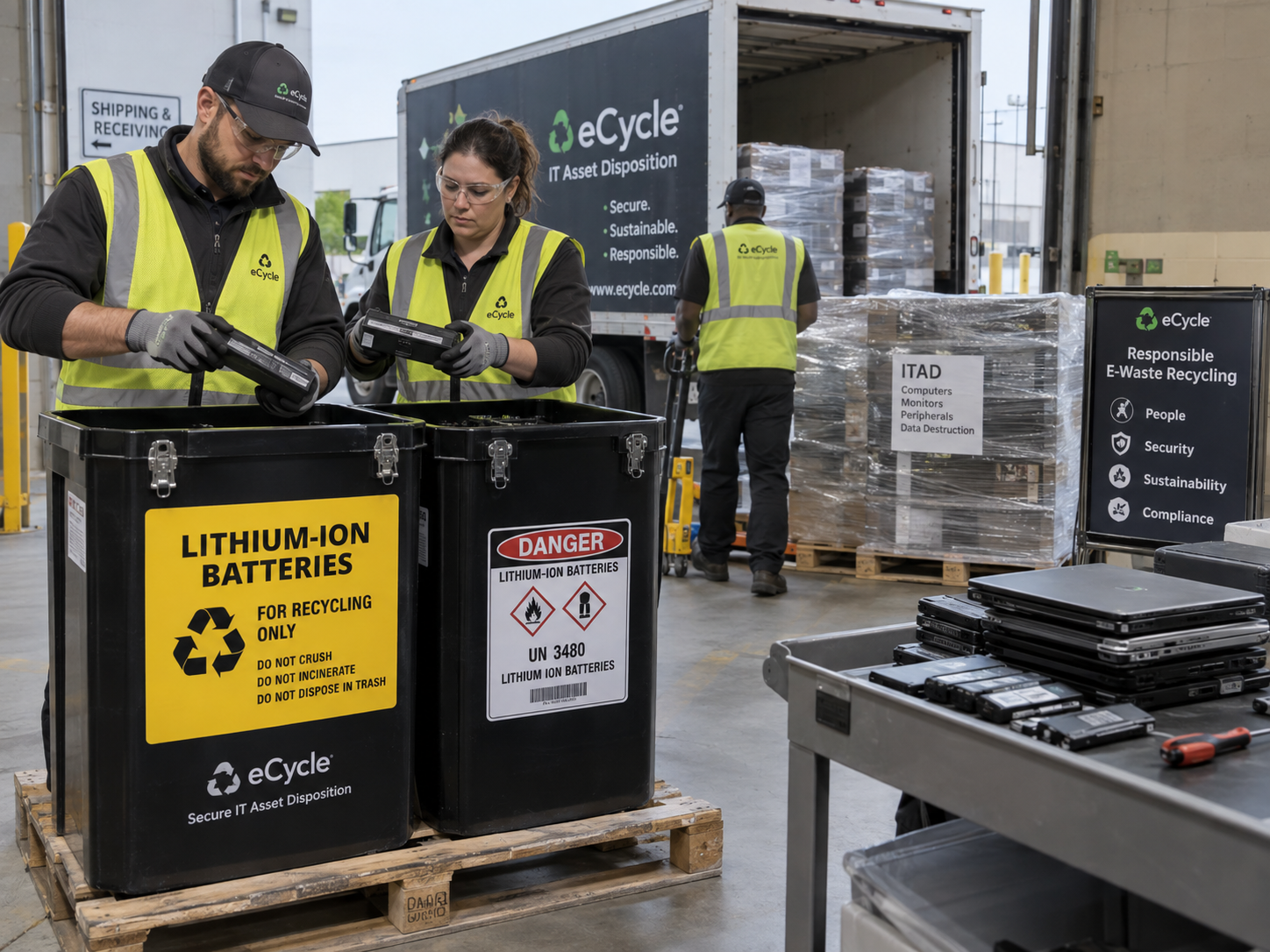
Store intact batteries in closed, structurally sound, compatible containers labeled “Universal Waste – Batteries” with the accumulation start date, terminals taped, between 15°C and 30°C, for no more than one year. Store damaged batteries separately in a UN-rated drum filled with non-combustible suppressant. Keep total stored energy under 20 kWh per fire area.
Intact batteries
Under 40 CFR 273.14, every container must carry “Universal Waste – Batteries,” “Waste Batteries,” or “Used Batteries,” plus the Accumulation Start Date. Missing or illegible dates are the most frequent RCRA violation state and federal inspectors cite during walkthroughs. Date the bin. Under 40 CFR 273.13, containers must be closed, structurally sound, and chemically compatible. You may sort by chemistry, tape terminals, and remove batteries from products. You may not treat, crush, or shred. Hold the room at 15°C to 30°C (59°F to 86°F) and below 65 percent humidity, with batteries at 40 to 60 percent state of charge.
Damaged batteries
Cardboard boxes and plastic bins are dangerously insufficient for a swollen or leaking battery. Use a UN-rated metal or rigid plastic drum and fill the void with a non-combustible, non-conductive, thermally insulating suppressant. Sand works; engineered glass granulates such as CellBlockEX are the current standard because they absorb heat, smother flame, and filter toxic off-gassing. OSHA changes here too: under 29 CFR 1910.1200 an intact battery is an exempt “article,” but a breached one may off-gas hydrofluoric acid, so keep the Safety Data Sheet accessible and label the container.
| Requirement | Intact batteries | Damaged / defective / recalled |
|---|---|---|
| Container | Closed, structurally sound, compatible bin | UN-rated metal or rigid plastic drum |
| Fill | Terminals taped | Void filled with non-combustible, non-conductive suppressant |
| Labeling | “Universal Waste – Batteries” + accumulation start date | Same, plus OSHA hazard warnings; SDS accessible |
| OSHA status | Exempt “article” | Article exemption lost |
| Max on-site time | One year from generation | One year; ship as soon as practical |
| Conditions | 15–30°C, <65% humidity, 40–60% SoC | Same; physically isolated from other stock |
The fire code threshold most IT teams miss
The 2024 International Fire Code, Section 1207, sets the trigger for indoor lithium-ion storage in commercial facilities at 20 kilowatt-hours aggregate. An enterprise laptop battery holds about 50 to 60 watt-hours, so roughly 350 to 400 batteries in one closet can cross the line. Past it, the Maximum Allowable Quantity caps storage at 600 kWh per fire area, and exceeding that requires a hazard mitigation analysis backed by UL 9540A fire-test data. Disperse stock across separate fire-rated zones, or schedule pickups well before 20 kWh.
One caveat: these codes were written for stationary storage wired to the building, and local Authorities Having Jurisdiction disagree on whether pallets of dead laptop batteries count. Ask yours. And since federal law sets no lithium-specific accumulation limit shorter than one year, move batteries out quarterly anyway. Legal is not the same as wise.
How Should Lithium-Ion Batteries Be Transported for Recycling?
Ship intact batteries by ground under the 49 CFR 173.185(d) recycling exception: strong outer packaging, motor vehicle only, to a permitted recycler or storage facility. Ship damaged batteries under 173.185(f) or through a vendor operating under a DOT Special Permit. Do not ship end-of-life IT batteries by air.
Class 9 and the watt-hour tiers
Under 49 CFR Parts 171–180, every lithium-ion battery is Class 9 hazardous material: UN3480 when loose, UN3481 when installed in or packed with equipment. From there, 173.185(c) grants relief by energy capacity:
| Tier | Cell limit | Battery limit | Mode and key requirements |
|---|---|---|---|
| Small (excepted) | ≤20 Wh | ≤100 Wh | Ground or air. Non-conductive inner packaging, strong rigid outer packaging, Lithium Battery Mark. No hazmat shipping papers or Class 9 label. Most laptops and tablets fall here. |
| Medium (excepted, ground only) | ≤60 Wh | ≤300 Wh | Highway or rail only. Lithium Battery Mark plus “LITHIUM BATTERIES—FORBIDDEN FOR TRANSPORT ABOARD AIRCRAFT AND VESSEL.” No hazmat papers. Covers extended workstation packs and small UPS modules. |
| Large (fully regulated) | >60 Wh | >300 Wh | Class 9 label, UN specification packaging, formal hazmat shipping papers, hazmat-endorsed driver. |
The exception built for you: 173.185(d)
A lithium battery shipped for disposal or recycling by motor vehicle to a permitted storage facility or recycler is excepted from UN 38.3 design-test record-keeping and from UN specification packaging. It needs only “strong outer packaging” that prevents short circuits and movement. Two hard limits: ground only, and no damaged, defective, or recalled batteries.
Damaged batteries: 173.185(f) and the special permits
DDR batteries are forbidden from air transport, no exceptions. By ground, the baseline rule at 173.185(f) historically allowed one battery per package. One swollen battery per drum, times a thousand laptops, is not a program. DOT Special Permits, issued by PHMSA when a shipper proves equivalent safety, let vendors consolidate:
| Rule or permit | What it requires or allows | Relief |
|---|---|---|
| 49 CFR 173.185(f) baseline | Each battery in its own non-conductive inner packaging, non-combustible thermally insulating cushioning, rigid thermally rated outer packaging, marked “Damaged/defective lithium ion battery” in letters ≥12 mm | None; historically one battery per package |
| DOT-SP 16532 | Multiple small DDR batteries (≤60 Wh per cell, ≤300 Wh per pack) in one 55-, 30-, or 5-gallon metal or plastic drum with fire suppressant | Bypasses one-battery-per-package |
| DOT-SP 20549 | Up to 132 lb (60 kg) of DDR batteries per UN-rated drum, often with CellBlockEX glass-granulate media | Waives inner packaging and terminal taping; permits co-mingling DDR with non-DDR batteries |
| DOT-SP 21442 | DDR batteries up to 1,800 Wh in pressure-venting steel drums | Exempts shipper from hazmat training, shipping papers, and Class 9 marking (49 CFR Part 172, subparts C–H) |
Why ground, not air
By air, IATA rules take over. Loose batteries (UN3480, Packing Instruction 965) must be discharged to no more than 30 percent state of charge and are barred from passenger aircraft. Batteries packed with equipment (PI 966) face the same rule from January 1, 2026; for batteries installed in the device (PI 967), IATA recommends 30 percent. Nobody boxing a powered-down, enterprise-locked laptop can verify that. Route all IT returns through LTL ground freight.
Marking changes and penalties
PHMSA’s HM-215Q rule, mandatory since April 10, 2025, requires a watt-hour marking on every lithium-ion battery, and old Lithium Battery Marks with an emergency phone number are prohibited after December 31, 2026. PHMSA and FAA levy six-figure civil penalties for undeclared or improperly packaged hazmat.
How Do You Choose a Qualified Battery Recycler or ITAD Vendor?
Choose a vendor that works with R2v3 or e-Stewards certified vendors or ones that hold those certifications themselves, treats batteries as Focus Materials with documented due diligence to final disposition, and returns a Certificate of Recycling traceable to your serialized asset list. Under CERCLA you remain liable after handoff, so your vendor’s downstream is your downstream. Ask before you sign.
What an ITAD actually does with your batteries
Very few ITAD vendors hold the EPA RCRA Part B destination-facility permits needed to shred, leach, or smelt batteries in-house. The vast majority of R2v3 and e-Stewards certified ITADs operate as Universal Waste handlers, not chemical processors. Human-I-T works the same way: we extract batteries during triage and data destruction, package them to DOT rules, and route chemical processing to specialized downstream recyclers.
That handoff is the exposure. Under CERCLA you are strictly liable from cradle to grave: if your ITAD hands batteries to a broker whose downstream abandons the material or contaminates a site, you can be named a Potentially Responsible Party for remediation. The vendors to avoid are the ones who broker batteries with no downstream audit and call it recycling.
What the certifications require
R2v3 Core Requirement 8 names lithium-ion batteries as Focus Materials and mandates 100 percent due diligence on every downstream vendor to final disposition: documented material flow, verified RCRA Part B TSDF permits, environmental liability insurance, annual audits. Appendix A requires any controlled stream sent to a non-R2v3 downstream be audited to R2v3 equivalence; Core Requirement 10 covers compliant packaging and shipping. e-Stewards tracks to absolute final disposition, often three or more tiers, verifies with covert GPS (EarthEye), and prohibits export of hazardous e-waste to developing nations, which R2v3 permits under Basel compliance. A mature program asks for R2v3 plus NAID AAA and ISO 14001, and follows ISRI and NAID guidance to serialize the host device at extraction so the final facility’s Certificate of Recycling traces back to you.
Ask your ITAD provider
- Are you or your downstream partners R2v3 or e-Stewards certified, and do you possess NAID AAA for data destruction? Show me current certificates.
- Who is the final disposition facility for my batteries, what RCRA Part B permit does it hold, and can I see the audit file for every tier in between?
- Can you serialize my devices at extraction so the battery lot’s Certificate of Recycling traces to my asset list?
- Which DOT Special Permits do you or your carrier hold, and what happens when I send a device with a swollen battery inside?
- Do you export batteries or black mass, and under what Basel documentation?
- Do IEEE 2883-2022 sanitization and battery extraction share one chain of custody and one set of records?
What Happens to the Batteries After They Leave Your Facility?
At the destination facility your batteries are discharged and shredded into “black mass,” a granular powder of cathode and anode material holding lithium, cobalt, nickel, and manganese. At that point they lose Universal Waste status and revert to fully regulated hazardous waste. Three recovery pathways exist. Hydrometallurgy processes most laptop-class batteries in the U.S. today.
Black mass and the end of Universal Waste
According to EPA’s 2023 memorandum, once a battery reaches a permitted destination facility and is shredded, it is again regulated under standard RCRA. Shredding separates foils, plastics, steel, and black mass, which keeps the toxicity and reactivity of its ingredients and remains hazardous waste while stored before reclamation.
Three pathways
Pyrometallurgy smelts cells above 1,500°C into a cobalt-nickel-copper alloy that still needs hydrometallurgical refining; lithium and manganese are lost to slag, and emissions are high. Hydrometallurgy leaches black mass in sulfuric acid and hydrogen peroxide into battery-grade nickel, cobalt, and manganese sulfates and lithium carbonate, at the cost of large chemical wastewater volumes. Direct (cathode) recycling dismantles rather than shreds and relithiates the cathode powder for reuse. According to Argonne National Laboratory lifecycle assessments, it can cut carbon emissions by up to 61 percent versus virgin mining, but it is pre-commercial, at pilot scale through the DOE ReCell Center, and needs batteries sorted by exact chemistry.
| Mineral | Pyrometallurgical recovery | Hydrometallurgical recovery | Direct recycling recovery |
|---|---|---|---|
| Cobalt (Co) | ~90–95% (as mixed alloy) | 96–99% (as pure salt) | >95% (as intact cathode) |
| Nickel (Ni) | ~90–95% (as mixed alloy) | 96–99% (as pure salt) | >95% (as intact cathode) |
| Manganese (Mn) | <10% (lost to slag) | 95–99% (as pure salt) | >95% (as intact cathode) |
| Lithium (Li) | 0–10% (lost to slag) | 90–96% (as lithium carbonate) | >95% (as intact cathode) |
Source: 2022–2025 operational data as modeled by the DOE ReCell Center and Argonne National Laboratory BatPaC V5.0 techno-economic assessments.
Why hydrometallurgy wins for laptops
Laptop fleets mix lithium cobalt oxide, nickel manganese cobalt, and nickel cobalt aluminum chemistries in 18650 cylinders and foil pouches. Hydrometallurgy processes that mixed black mass; direct recycling breaks if you mix LCO and NMC. That is why certified recyclers route laptop-class batteries to hydrometallurgical facilities.
What the data cannot tell you: recovery rates are not disaggregated by laptop chemistry, Argonne and NREL data skews toward EV streams, and no verified commercial-scale numbers exist for direct recycling. When a vendor quotes a recovery percentage, ask which pathway the final facility runs and what the number rests on.
How Should Battery Disposal Integrate with Your Broader ITAD and Sustainability Programs?
Treat battery disposition as a step inside your ITAD workflow, not a separate waste program. The same laptop needs IEEE 2883-2022 data sanitization and compliant battery extraction, and one serialized record should prove both. Those records also serve CERCLA defense and ESG disclosure under GHG Protocol Scope 3 Category 5, GRI 306-4, CDP C6.5, and ESRS E5-5.
One device, one chain of custody
IEEE 2883-2022 sanitization happens in access-controlled, often NAID AAA certified, environments; battery extraction happens in the same triage pass; and the serial recorded at intake should map to the battery lot and its Certificate of Recycling. Our guide to when to recycle, donate, or resell retired IT assets covers how that pass decides a device’s next life.
What the records do for ESG reporting
The same Certificates of Recycling and serialized manifests that protect you under CERCLA are your evidence base for disclosure. One rule governs their use: the GHG Protocol prohibits netting “avoided emissions” from material recovery against your inventory. Routing batteries and devices to recovery lowers the mass in your Category 5 waste line; avoided emissions are calculated and reported separately, alongside it, never subtracted. Here is where ITAD records fit each framework:
| Framework | What it asks for | Where your ITAD records fit |
|---|---|---|
| GHG Protocol Scope 3, Category 5 (Waste Generated in Operations) | Emissions from third-party treatment of your e-waste, as mass times a treatment emission factor | Lot-level weights by disposition (reuse, recycling, disposal) |
| GRI 306: Waste 2020, Disclosures 306-4 and 306-5 | Metric tons diverted from disposal, split by reuse, recycling, other recovery; tons directed to disposal | Mass-balance report reconciling inbound weight with outbound disposition |
| CDP C6.5 | Scope 3 CO2e for Capital Goods and Waste Generated in Operations, with methodology | Environmental Impact Report validated against ISO 14064-3 or EPA WARM |
| CSRD ESRS E5-5 (Resource Outflows) | Weight of waste diverted, split hazardous and non-hazardous | Battery lots in the hazardous column, with Certificates of Recycling |
| California SB 253 | Scope 3 reporting phased in from 2027; limited assurance from 2030 | Traceable data, evidence files, documented methods that survive a third-party auditor |
Credible vendors provide lot-level Environmental Impact Reports (metals recovered, toxics diverted) and mass-balance reporting. Ask for the methodology, not the infographic.
Budget at procurement, and write one SOP
California’s SB 1215 charges the recycling fee on embedded-battery devices at purchase. Battery disposition belongs in lifecycle budgeting when you buy the fleet, not when you retire it.
Then write one national procedure that defaults to the strictest state you operate in: climate-controlled storage, rigid accumulation dating, immediate isolation of compromised units, ground-only transport under 173.185(d), special-permit carriers for DDR, and vendor due diligence to final disposition. Satisfy California and Massachusetts and you satisfy everyone.
Decision Framework: In-House, Take-Back, or Certified ITAD?
| Decision variable | Handle in-house (IT team) | Manufacturer take-back program | Certified ITAD vendor (R2v3 / e-Stewards) |
|---|---|---|---|
| Intact laptop batteries (routine refresh) | Triage, labeling, and Universal Waste accumulation only; no treatment or recycling on-site | Feasible for small quantities; New York’s 10-per-person-per-day retail cap and similar limits make it impractical at fleet scale | Extraction, DOT-compliant packaging, and routing to audited downstream processors under one chain of custody |
| Damaged / swollen / DDR batteries | Isolate whole device in fire-retardant container; do not remove; needs 173.185(f) packaging or a special-permit carrier | Generally excluded; most programs will not accept damaged units | Access to DOT Special Permits (16532, 20549, 21442) and suppression drums for consolidated DDR shipping |
| Data security integration | Separate process; not linked to data sanitization | None; take-back programs do not perform data destruction | IEEE 2883-2022 sanitization and battery extraction under one serialized record; NAID AAA where held |
| CERCLA liability protection | You are the generator and remain liable; no downstream documentation generated | Limited; producer-run, but you still need proof of transfer | R2v3 CR8 downstream due diligence and Certificates of Recycling traceable to your asset list; audit the vendor anyway |
| Multi-state regulatory compliance | Your team must track every state’s Universal Waste deviations and EPR rules | Terms vary by state and assume consumer volumes | Vendor operates across jurisdictions under approved state plans; enterprise should still verify |
| Recommended fleet size (rule of thumb) | Under about 50 devices per year: in-house triage and labeling, then hand off | Under about 100 devices per year in a single state with an active program | 100 or more devices per year, any multi-state footprint, or any DDR volume |
Fleet-size thresholds are a practitioner’s rule of thumb, not a standard.
Frequently Asked Questions
How do I dispose of a swollen laptop battery?
Do not remove it. Power the device down, place the whole laptop in a fire-retardant container or a UN-rated drum of non-combustible suppressant, label it, and keep the Safety Data Sheet accessible. Ship by ground only, under 49 CFR 173.185(f) or through an ITAD whose carrier holds a DOT Special Permit.
Can you throw lithium batteries in the trash?
No. EPA’s May 24, 2023 memorandum classifies most spent lithium-ion batteries as hazardous waste for ignitability (D001) and reactivity (D003), so trash or standard recycling disposal violates RCRA. Minnesota, New York, and California enforce explicit bans. Businesses must manage them as Universal Waste and route them to a permitted recycler.
How does bulk battery recycling work for businesses?
Accumulate intact batteries in closed, dated containers labeled “Universal Waste – Batteries” for up to one year, then ship by ground under the 49 CFR 173.185(d) recycling exception to a permitted recycler or certified ITAD. Damaged batteries ship separately. Ask for Certificates of Recycling traceable to your serialized asset list.
How many laptop batteries trigger fire code?
Roughly 350 to 400. The 2024 International Fire Code Section 1207 sets the lithium-ion trigger at 20 kWh aggregate, and an enterprise laptop battery holds about 50 to 60 Wh. Local fire officials disagree on whether pallets of dead batteries count, so ask yours, and schedule pickups before you approach the line.
Do I need a hazmat manifest to ship laptop batteries?
Usually not. Intact batteries managed as Universal Waste are exempt from RCRA manifesting, and the 49 CFR 173.185(d) recycling exception drops UN specification packaging for ground shipments to a permitted recycler. Packs under 100 Wh need only strong packaging and the Lithium Battery Mark. Damaged batteries and packs over 300 Wh are different.
What is black mass?
Black mass is the granular powder left after a recycler discharges and shreds lithium-ion batteries and removes foils, plastics, and casings. It holds the cathode and anode materials: lithium, cobalt, nickel, and manganese. EPA regulates it as hazardous waste while stored before reclamation because it keeps the toxicity and reactivity of its ingredients.